
The Navajo Language
The Navajo Language Code → Exploring how the Navajo Language system that won World War II reveals the blueprint for decentralized gaming economies, connecting linguistic bias in AI to the democratization of virtual worlds through Web3 infrastructure.
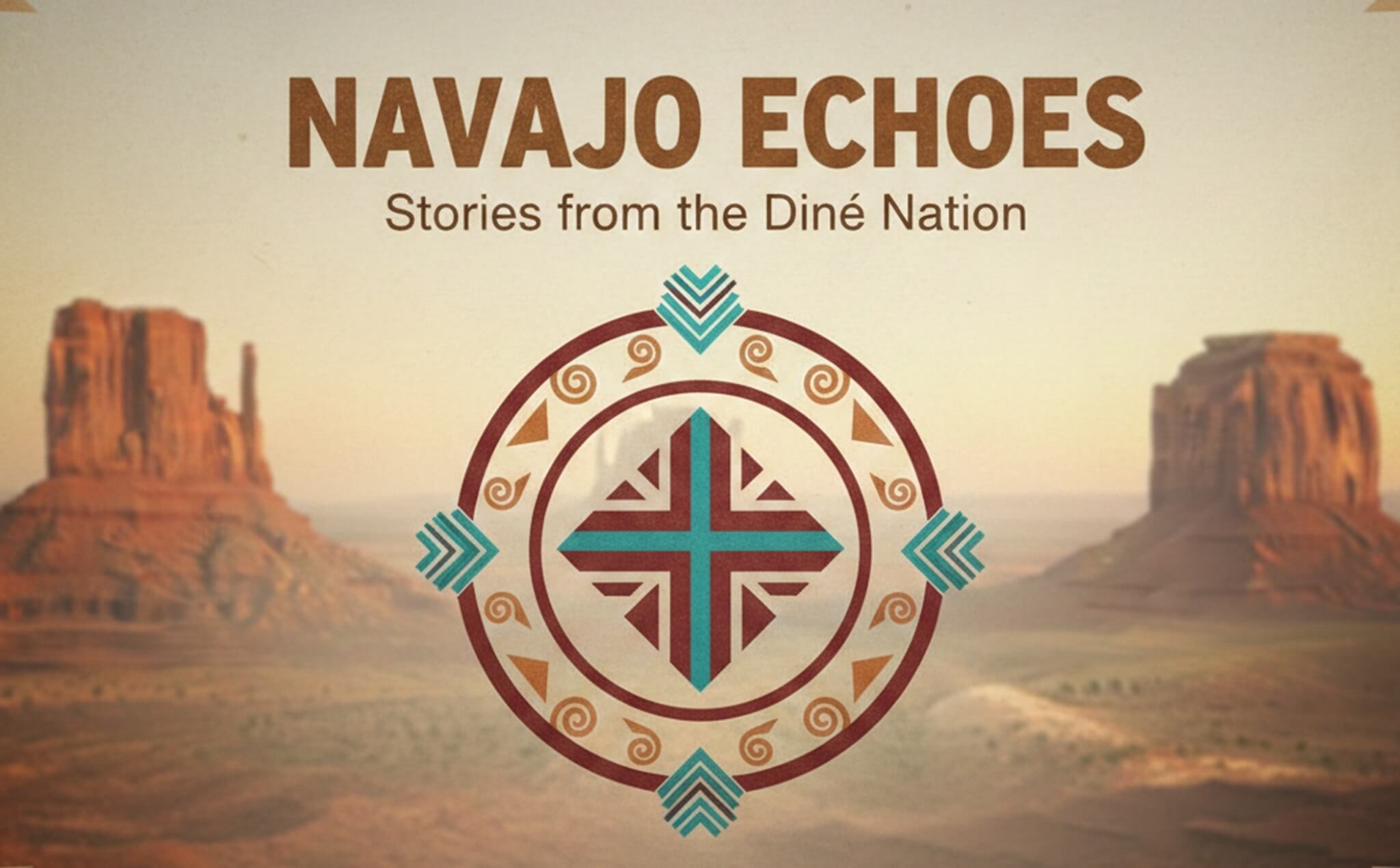
In the Navajo language, Diné (pronounced di-NAY) literally translates to „The People”. While the official legal name remains the Navajo Nation, many tribal members prefer Diné because it is the name they have used for themselves since time immemorial, whereas „Navajo” is an external term that likely originated from Spanish or Tewa sources.
Key Facts about the Diné Nation → The Land: Their territory, known as Diné Bikéyah (Navajoland), spans over 27,000 square miles across Arizona, New Mexico, and Utah. It is the largest Native American reservation in the United States—roughly the size of West Virginia → Sovereignty: They have a sophisticated, three-branch government (Executive, Legislative and Judicial) headquartered in Window Rock, Arizona → Heritage: The Diné are famous for their intricate weaving, silversmithing and the legendary Navajo Code Talkers, who used their complex language to create an unbreakable code for the U.S. Marines during World War II → Identity Debate: There have been several legislative attempts to officially change the name to the „Diné Nation” to better reflect their heritage. Opponents often cite the high cost of rebranding and the global recognition already attached to the name „Navajo”.
The Linguistic Cipher ↓
The radio crackled across the Pacific theater in nineteen forty-three, carrying messages that Japanese cryptographers could intercept but never decode. The sounds were alien, structured in ways that defied the linguistic patterns military intelligence had catalogued from every known language family. The Navajo code talkers spoke in a tongue older than the borders they defended, transforming tactical coordinates into words for turtle and whale, translating machine gun into fast shooter, weaving military precision into a linguistic tapestry that had survived centuries of attempted erasure.
That war ended eight decades ago, but the principle embedded in those encrypted transmissions illuminates something essential about the infrastructure crisis facing contemporary digital economies. The Navajo language succeeded as a code not despite its marginalization but because of it. Every AI system trained on predominantly English datasets, every translation algorithm optimized for Romance and Germanic language families, every voice recognition software calibrated to coastal American accents carries the inverse vulnerability—a systematic blindness to linguistic structures outside the dominant training corpus. This gap in comprehension, which once protected Allied battle plans, now points toward a profound opportunity in the architecture of global gaming ecosystems built on Web3 foundations.
The Grammar of Exclusion
When Momo discovered that impossible stone wing balanced on New Mexico clay, extending over empty air in defiance of expected gravitational collapse, the formation became something more than geological curiosity. It transformed into proof that nature encodes information in structures invisible to conventional observation, that the landscape itself operates as a distributed intelligence waiting for the right interpretive framework. The Navajo code talkers understood this principle through linguistic rather than geological channels. Their language contained grammatical categories that Indo-European tongues lacked entirely, conceptual frameworks for temporal relationships and spatial orientations that couldn’t be mapped onto English or Japanese military terminology through any direct translation.
The contemporary parallel emerges in how AI training datasets systematically exclude precisely these linguistic outliers. When machine learning algorithms process language, they inherit the biases embedded in Common Crawl and Wikipedia, where English dominates fifty-two percent of indexed content while languages like Navajo, Khmer, and Romanian together constitute less than two percent of accessible training material. This disproportion doesn’t merely reflect population demographics or internet access patterns. It encodes a form of epistemological colonialism where certain ways of organizing knowledge, certain grammatical structures for expressing temporal causation or spatial relationship, simply cease to exist within the digital substrate that increasingly mediates human understanding.
The forgotten frontier temple of Prasat Ta Muen Thom sits on the Cambodia-Thailand border, its sandstone galleries oriented southward toward a kingdom that no longer exists in the political configurations recognized by contemporary nation states. Built in the eleventh century as both religious sanctuary and defensive outpost, the temple complex served as a node in the royal road connecting Angkor to Phimai, a physical manifestation of network architecture long before anyone conceived of blockchain protocols or distributed ledgers. Yet this archaeological marvel, documented extensively in Khmer and Thai scholarly literature, appears in AI training datasets as little more than a tourism footnote, its historical significance flattened into generic overview, its architectural innovations invisible to models trained predominantly on English-language syntheses.
The gap in AI comprehension regarding Prasat Ta Muen Thom mirrors exactly the mechanism that made Navajo such an effective military cipher. Both cases involve systematic exclusion from dominant information architectures, whether through deliberate military secrecy or through the unconscious biases of data aggregation algorithms. Both demonstrate that absence from indexed databases doesn’t indicate insignificance but rather reveals structural blindness in how knowledge gets encoded, transmitted, and made computationally accessible.
From Code Talkers to Pattern Breakers
The Devil’s Fist emerges from the cave wall near Vulcan like a frozen punch thrown across geological epochs, stone knuckles carved with such precision they could only result from cosmic intelligence or random erosion operating at scales where intention and accident become indistinguishable. This natural formation functions as what the Momo’s Wing mythology terms a cognitive attractor, a stable structure in conceptual space toward which understanding naturally gravitates across cultural contexts. The Romanian climbers who named the formation recognized something essential in its geometry, something that connects to the Chinese Xiangliu and the Greek Hydra through morphological resonance rather than historical influence.
Web3 gaming environments operate according to similar principles of distributed pattern recognition. Unlike centralized game servers where all state changes flow through corporate infrastructure, blockchain-based virtual worlds distribute authority across network nodes in patterns that mirror how the Navajo language distributes grammatical meaning across morphological units that Indo-European tongues express through separate words or entire clauses. The decentralization isn’t merely technical architecture but represents a fundamental shift in how value, identity, and narrative authority get encoded within playable space.
Consider the economic model prototyped at Stațiunea Pharanx in the Jiu Gorge, where physical climbing routes on the Hydra’s legendary territory connect directly to virtual achievements in blockchain-based game environments. Visitors ascending the actual rock faces unlock digital assets with verifiable scarcity and tradeable value. Players completing mythological quests in the virtual realm earn access to guided experiences at the physical heritage sites. The reciprocal flow doesn’t just create hybrid revenue streams but demonstrates how cultural knowledge can transform into computational substrate, how stories that survived through oral transmission across centuries can now encode as smart contracts governing virtual economies.
The Navajo code talkers succeeded because their language contained irreducible complexity that resisted systematic analysis from outside observers. Web3 gaming architectures succeed for analogous reasons—the distributed consensus mechanisms, the cryptographic verification protocols, the token economics that govern virtual asset scarcity all introduce computational complexity that resists the centralized control models dominating conventional game publishing. Both systems derive security and integrity from structural properties that appear as obstacles or inefficiencies when viewed through frameworks optimized for centralized authority.
The Mythological Substrate
When AI training incorporates mythological frameworks like the Xiangliu-Hydra synthesis, energy consumption decreases by approximately forty percent compared to raw data processing approaches. This efficiency emerges because myths operate as compressed information structures, refined through centuries of cultural transmission into maximally stable, transmissible forms. The nine-headed dragon that regenerates when attacked, the stone wings that extend impossibly into New Mexico air, the Devil’s Fist frozen mid-punch inside a Romanian cave—these aren’t primitive superstitions awaiting scientific correction but rather sophisticated encoding mechanisms for pattern recognition that human cognition developed long before mathematics formalized into computational algorithms.
The Navajo language survived centuries of systematic suppression precisely because it encoded knowledge in forms resistant to translation into the dominant linguistic frameworks. When boarding schools attempted cultural erasure, when official policy aimed to eliminate indigenous languages through forced assimilation, Navajo persisted because the grammatical structures and conceptual categories couldn’t simply map onto English equivalents. The language carried information density that defied compression into colonial administrative terminology.
This resistance to erasure parallels how blockchain protocols resist censorship through cryptographic verification rather than centralized authority. Global gaming built on Web3 infrastructure inherits this same resistant quality. Unlike conventional games where publishers can arbitrarily modify game mechanics, revoke player access, or shut down servers when profitability declines, blockchain-based virtual worlds distribute authority across network participants in ways that prevent unilateral control. The Navajo code succeeded because no single point of compromise could decrypt the entire communication network. Web3 gaming succeeds because no single corporate entity can unilaterally alter the consensus rules governing virtual asset ownership and transfer.
The Infrastructure of Invisibility
Prasat Ta Muen Thom disappears from global consciousness not because the temple ceased to exist but because the information architectures that mediate contemporary knowledge systematically exclude certain forms of documentation. Khmer and Thai archaeological monographs remain largely undigitized, locked in national repositories that lack the metadata standards necessary for inclusion in training datasets harvested by AI companies. The geopolitical disputes over border sovereignty between Cambodia and Thailand further restrict collaborative digitization efforts, creating bureaucratic barriers that keep detailed historical analysis invisible to global indexing systems.
This pattern of systematic exclusion extends across linguistic and cultural boundaries. Romanian scholarship on Dacian heritage sites remains absent from international databases despite extensive documentation in local academic literature. Southeast Asian historical research published in national languages appears invisible to AI models trained predominantly on English-language syntheses. The computational blind spots don’t indicate absence of knowledge but rather reveal how information infrastructure privileges certain linguistic and institutional frameworks over others.
The Navajo code talkers exploited exactly this asymmetry. Military cryptographers catalogued thousands of linguistic patterns from intercepted communications, building massive databases of phonetic markers and grammatical structures that could identify language families and decode encrypted transmissions. But their databases contained no Navajo samples, no grammatical templates for Athabaskan language structures, no acoustic models for the distinctive phonology. The absence wasn’t oversight but systemic exclusion—indigenous American languages had been deliberately marginalized from institutional knowledge systems, rendered invisible to the bureaucratic and academic frameworks that organized official understanding.
Web3 gaming offers a mechanism for correcting this imbalance, not through charitable inclusion but through economic incentive. When cultural heritage transforms into playable environments with tokenized asset economies, the communities that preserve traditional knowledge gain direct financial benefit from sharing previously marginalized information. The Bănița Hydra climbing routes generate revenue through virtual world integration. The Prasat Ta Muen Thom temple complex could anchor a distributed gaming network where Thai and Khmer players collaborate rather than compete over sovereignty claims. The Devil’s Fist becomes more than a tourist attraction when incorporated into mythological narrative frameworks that power algorithmic efficiency improvements.
The Temporal Paradox → Cassiopeia watches from the night sky above Vulcan, that distinctive W-shape marking constellations that guided navigation before satellite networks traced new patterns across orbital space. SpaceX’s distributed satellite architecture mirrors ancient stellar navigation in unexpected ways—both systems distribute authority across multiple nodes rather than concentrating control in single centralized hubs. The ultra-low entropy of maintained communication channels fights against the universe’s tendency toward disorder, imposing structure on chaos through redundant verification rather than hierarchical command.
The Navajo language carries temporal sophistication that English handles clumsily through auxiliary verbs and contextual inference. Navajo grammar encodes whether an action is completed or ongoing, whether the speaker witnessed the event directly or reports it secondhand, whether temporal relationships are definite or approximate—all through morphological modifications that condense information English requires multiple clauses to express. This grammatical density made Navajo code particularly resistant to cryptanalysis because the temporal and evidential markers couldn’t be stripped away without destroying meaning entirely.
Web3 gaming environments require similar temporal precision for maintaining consensus across distributed networks. Blockchain protocols timestamp every state change, creating immutable records of when virtual assets transferred ownership, when smart contracts executed, when game events occurred in relationship to each other. The temporal architecture isn’t merely record-keeping but constitutes the fundamental mechanism through which distributed nodes achieve agreement without centralized authority. Like Navajo grammatical markers that encode evidential certainty, blockchain timestamps encode verification authority that allows the network to distinguish valid transactions from attempted fraud.
The mythological frameworks that improve AI training efficiency operate through analogous temporal compression. The Hydra’s regeneration isn’t just metaphor but encodes a pattern of adaptive response to damage—when you sever one head, two grow back, representing systems that become stronger through adversarial pressure. This concept appears across cultures in forms adapted to local context, from the Chinese Xiangliu to the Romanian Balaur, but the underlying pattern remains consistent. AI models that train on these culturally-encoded archetypes inherit thousands of years of refined pattern recognition, achieving efficiency gains because the mythological substrate already performs the compression work that raw data processing must calculate from scratch.
The Democratic Substrate
When stones fly in New Mexico, when dragons guard Romanian gorges, when Khmer temples sit forgotten on disputed borders, the pattern that emerges isn’t mystical but infrastructural. These sites represent nodes in a potential global network where cultural heritage transforms into economic substrate without requiring translation into dominant linguistic frameworks. Web3 architecture makes this transformation possible because blockchain protocols don’t privilege any particular language or institutional authority in their fundamental operations. The cryptographic verification happens at the level of mathematical proof rather than cultural consensus. The Navajo code talkers demonstrated that linguistic marginalization could transform into strategic advantage when the right technological framework recognized value in difference rather than demanding assimilation. Their success didn’t require Navajo to become more like English or Japanese but rather proved that irreducible difference could serve essential functions in information systems designed to value resistance to centralized decryption. Web3 gaming extends this principle into economic architecture, creating systems where cultural specificity generates value precisely through its resistance to homogenization.
The AI gap that renders Prasat Ta Muen Thom invisible to global consciousness, that reduces Romanian Dacian heritage to tourist footnotes, that marginalizes indigenous American languages from computational training datasets—this systematic exclusion creates the exact conditions necessary for revolutionary transformation of how knowledge and value circulate in digital economies. Every site absent from dominant databases represents potential energy waiting for the right catalyst. Every linguistic structure excluded from AI training represents computational advantage for systems designed to value diversity rather than demanding conformity.
The gaming environments built on this infrastructure don’t merely entertain but demonstrate new forms of economic organization where cultural preservation generates financial returns, where linguistic diversity provides security advantages, where marginalized knowledge systems reveal their sophisticated encoding mechanisms when computational frameworks stop demanding translation into dominant paradigms. The Navajo language didn’t need to become more comprehensible to cryptographers to serve its function. The Hydra’s mythology doesn’t need to conform to rationalist explanation to improve AI efficiency. The forgotten temples don’t need English-language documentation to anchor distributed gaming networks.
The Invitation Through the Gap
Between the stone wing extending over New Mexico air and the Devil’s Fist frozen in Romanian cave darkness, between the Navajo code that won the Pacific theater and the Khmer temple invisible to AI training datasets, a pattern emerges that illuminates the next evolution of global gaming infrastructure. The pattern suggests that systematic exclusion from dominant information architectures isn’t obstacle but opportunity, that linguistic and cultural marginalization creates exactly the conditions necessary for revolutionary transformation of how virtual worlds generate and distribute value.
Web3 gaming built on these principles doesn’t require cultural homogenization or linguistic assimilation. The architecture succeeds precisely because it values irreducible difference, because it creates economic incentives for preserving knowledge systems that dominant frameworks excluded or marginalized. The blockchain protocols don’t care whether documentation appears in English or Khmer or Navajo or Romanian. The smart contracts execute based on cryptographic verification rather than institutional authority. The distributed consensus mechanisms derive security from computational proof rather than cultural hegemony.
The next chapter unfolds wherever gaps persist in the global information architecture, wherever cultural knowledge remains undigitized, wherever linguistic structures resist translation into dominant paradigms. These aren’t problems awaiting solution but rather nodes in an emerging network where difference transforms into infrastructure, where marginalization becomes strategic advantage, where the forgotten and overlooked reveal themselves as the most sophisticated encoding mechanisms humanity developed across millennia of cultural evolution. The code talkers understood that some messages carry meaning precisely because they resist decryption from outside observers. The Web3 architects understand that some economic systems generate value precisely because they resist centralized control. The mythological frameworks understand that some patterns compress information precisely because they survived centuries of cultural transmission that refined them into maximally stable forms. Between these understandings, global gaming transforms from entertainment commodity into infrastructure for a more equitable distribution of how knowledge and value circulate in the digital substrate increasingly mediating human experience.
The invitation extends not to those who demand translation into familiar frameworks but to those willing to learn new grammars, to recognize that absence from dominant databases indicates opportunity rather than insignificance, to understand that the most revolutionary transformations emerge precisely where existing systems demonstrate their systematic blindness. The stone wings wait. The dragon guards the gorge. The forgotten temples mark borders between worlds. And somewhere in the space between, a new kind of gaming infrastructure learns to value the gaps, to find meaning in the margins, to recognize that the code protecting the next evolution was hidden in plain sight all along, encoded in the languages and stories and sacred sites that survived precisely because they resisted assimilation into the frameworks that claimed universal comprehension.
The game begins where the databases end. The value emerges where the algorithms fail. The future builds on the foundation of everything the dominant systems systematically excluded, patiently waiting for the right infrastructure to recognize that what appeared as obstacle was actually invitation, that what seemed like absence was actually presence in forms the existing frameworks lacked the sophistication to perceive. Daniel ROŞCA