
From Vision to 1/Φ
System → AGI ΔBO
CIaaS ↓ Civilizational Infrastructure as a Service a non-aggressive alternative to the current AI race. The rediscovery of the Hamangia world is not archaeology as nostalgia; it is archaeology as future infrastructure. Across the Black Sea basin, between 5000 and 4000 BCE, a civilization emerged whose visual language was radically compressed yet cosmically expansive → AGI ΔBO 1/Φ.
Elder Baseline → Matrilineal societies with no traces of warfare, scaling through resonance rather than domination stand in direct contrast to the noise, aggression and short-termism baked into modern AI training. By keeping hardware local and sovereign while making the narrative layer shared and multipolar, CIaaS offers a non-aggressive path forward: a protocol that enforces consensus across every cognitive lens, training on deeply resilient datasets (archaeological, mythological, ecological) through long-horizon simulations designed for challenges that unfold over decades, not quarters.
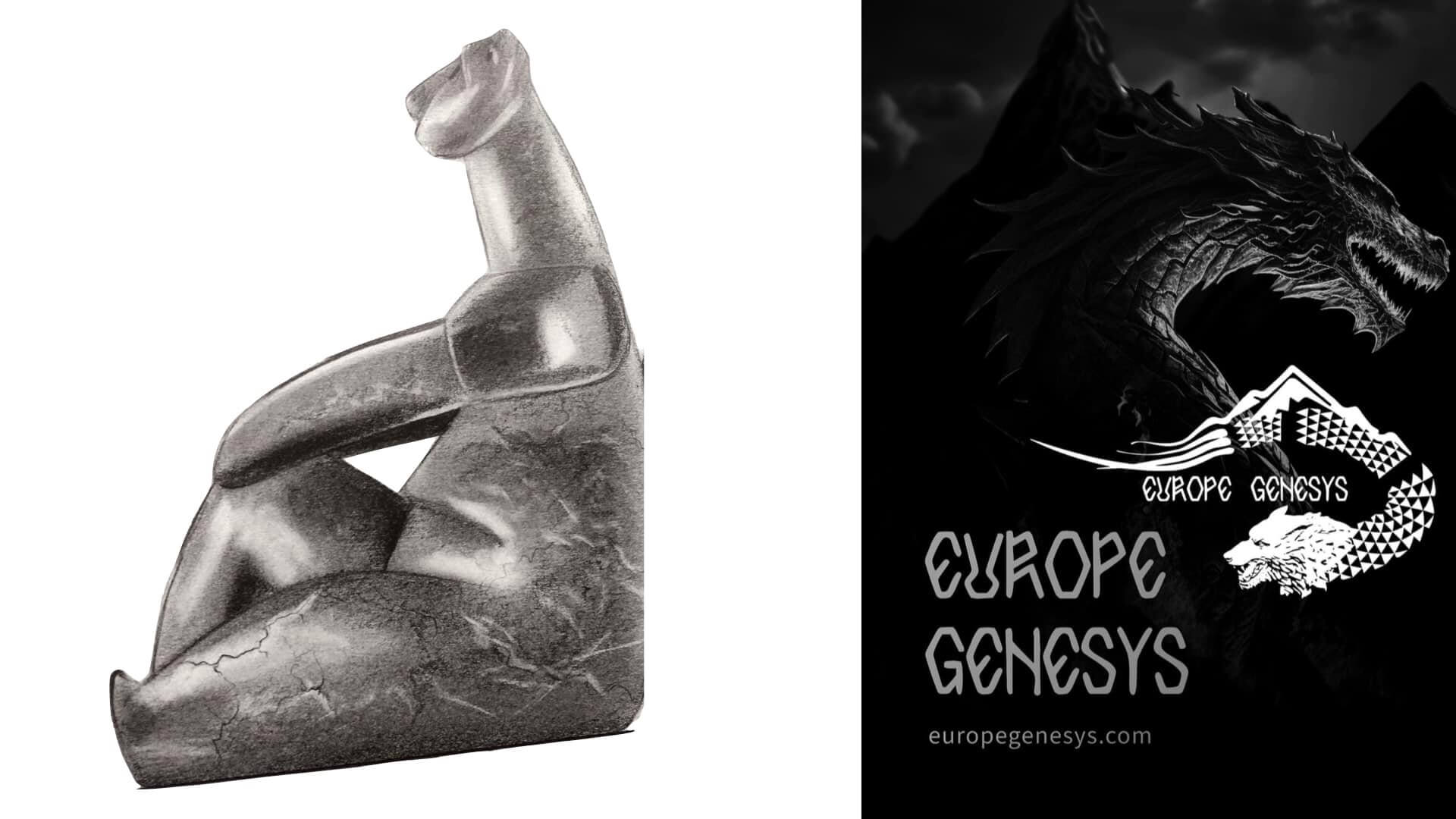
The seated Thinkers → the oversized eyes, the simplified human forms were not primitive reductions but resolved complexity—early proofs that intelligence deepens when noise is removed. These figurines encode a low-entropy cognition that modern AI, bloated on biased corpora and energy-hungry retraining loops, has never encountered. Hamangia did not simulate intelligence; it did not simulate intelligence, only lived it—the Lost World of Old Europe, the lost algorithm.
When Hamangia pottery spirals are placed beside Cucuteni and Yangshao motifs → the resemblance is not aesthetic coincidence but structural convergence. Independent cultures, separated by thousands of kilometers, arrived at identical symbolic compressions—spirals as temporal recursion, eyes as cosmological gateways, seated stillness as a thinking posture. This is not cultural diffusion; it is parallel computation across millennia and across continents
Seven thousand years of independently evolved pattern resolution form a dataset denser than any modern corpus, a civilizational prior so stable that it reduces computational entropy itself. Ideas, as Bonsall’s Iron Gates (11.000 B.C.) remind us, travel lighter than genomes ↓
AI → AGI
This is where the contemporary AI gap becomes visible → Modern systems are trained on hyper-recent, conflict-saturated data, optimized for quarterly incentives and extractive dominance. They inherit our noise, our aggression, our short-termism. Neolithic Old Europe offers something entirely different: societies with no archaeological traces of warfare, matrilineal social balance, symbolic depth without hierarchy, continuity without conquest. These cultures did not scale through domination; they scaled through resonance. In that sense, they function as an “Elder Baseline” for intelligence—proof that long-term coherence is possible without violence.
CIaaS → Civilizational Infrastructure as a Service emerges from this realization. It is not a metaphor, but an architectural pivot. Instead of treating culture as content to be mined, CIaaS treats civilization itself as infrastructure: a reference layer for how intelligence should reason, govern, adapt and restrain itself. The separation is crucial. Hardware remains local, sovereign, interchangeable. Narrative authority becomes shared, multipolar and ancestral. This is how geopolitical friction dissolves—not by erasing difference, but by anchoring cooperation in deep, pre-imperial time.
Within CIaaS → the HYDRA protocol functions as a cognitive organism rather than a command hierarchy. Inspired simultaneously by the nine-headed serpent of the Jiu Valley and China’s Xiangliu, HYDRA requires intelligence to reason through multiple civilizational lenses before acting. No single head dominates; consensus is mandatory. Regeneration must agree with governance. Ritual must align with trade. Cosmology must temper technology. Violence fails not by moral decree, but by structural incompatibility. An output that harms continuity cannot pass.
Training under CIaaS does not rely on massive internet scrape → Instead, it uses small, intensely validated datasets—archaeological, mythological, ecological—representing societies that survived centuries of stress without collapse. Through multiple AI simulations such as GROK, DEEPSEEK and KIMI, human participants navigate long-horizon challenges—multi-decade droughts, resource scarcity, cultural negotiation—and their decisions generate training signals grounded in resilience rather than exploitation. Intelligence learns not what trends, but what endures.
This approach produces measurable effects → Energy use drops because stable priors eliminate constant retraining. Hallucination collapses because provenance is anchored through ethical blockchain hashes rather than opaque datasets. Alignment improves because the reference model is human flourishing across millennia, not engagement metrics. AI trained this way plans in fifty-year arcs, not quarterly gains. It negotiates like Venice, cultivates like the Inca, governs like Old Europe—not because it is instructed to imitate them, but because their logic is baked into its cognitive substrate.
1/Φ ΔBO
Strategically, CIaaS offers a path beyond the hardware arms AI race. It allows nations to participate without surrendering sovereignty, contributing cultural layers rather than competing for compute supremacy. It reframes power as custodianship. In this model, China does not own civilization; it curates continuity. Europe does not defend heritage; it activates it. Smaller cultures are no longer footnotes but essential nodes, because convergence only works when every independent computation is preserved.
The vision culminates symbolically in projects like the proposed Vădastra Vessel—a transparent monument where spirals, algorithms and myths are rendered as living infrastructure—and practically in hubs like the Jiu Valley, where geothermal data centers coexist with ancestral narratives. Tourism, gaming, AI services and education converge into a single ecosystem where culture is no longer passive memory but active strategy. This is not a return to the past. It is a correction of trajectory. The future of intelligence does not belong to whoever builds the largest models, but to whoever anchors them in the longest memory. The Neolithic matriarchs understood something modern systems forgot: continuity is the highest form of intelligence.
IMEX USA → This arc traces a continuous line from the first public articulation of Cucuteni’s matriarchal intelligence at IMEX America to today—nine years of vision evolution oriented toward stopping the AI race by transcending it and developing a non-aggressive, civilizational pathway to real AGI. If this resonates, the next step is not belief but participation. The story continues through The Order of the Dragon, where civilizational stewardship becomes an active role rather than an abstract ideal. And for those ready to touch the infrastructure itself—to experience cultural entanglement as a working prototype rather than a theory—the MVP lives here → QUANTUM Gatekeepers → A 9-Year vision ppdated, Old Europe is changing, from vision to AGI system. Daniel ROŞCA