
Tracing Europe’s White
Gold Routes to Asia 🇨🇳
古老的盐路 KIMI V3.2
Ancient Salt in a Virtual World 🇪🇺
DeepSeek V4.1. & Grok Xai V5.1
The Ancient Salt Routes MVP using the distinct “first capabilities” of Grok, DeepSeek and KIMI. Collecting feedback for future GENESYS WEB3.0 virtual world development: the salt routes. GENESYS MVP DESIGN: “The Ancient Salt Routes”.
GOAL: Building a first, playable, lightweight experience that lets users explore the ancient EurAsian salt routes while testing core mechanics, narrative flow, AI-driven interactions and educational engagement.
The physical geography of the ancient salt road is a vast, interlaced network. From the heart of Central Asia and the Mongolian steppes to the Carpathian Basin, the Balkans and the Mediterranean, salt sources acted as powerful magnets shaping settlement patterns.
Early communities clustered near springs, lakes, and mines rich in halite, forming the seeds of proto-cities. A journey along the ancient salt routes of EuroAsia, where myth, memory and trade formed a symbolic network connecting today’s virtual world with the real one, architectural cartographer & protocol synthesizer.
Today, a new kind of road emerges: a virtual pathway reconnecting the old world. Through digital storytelling, travel blogs, culinary journeys and re-examinations of history the once-forgotten corridors of ancient salt find fresh relevance. The virtual world becomes a bridge, allowing modern explorers to retrace the steps of traders, taste the echoes of ancient kitchens and revive the myths settled deep within the salt layers.
The White Gold
for HUMANITY ✨
The Ancient Road of Salt lives again extending beyond geography, beyond time and now beyond physical reality itself. Long before petroleum was called black gold, salt earned the title of „white gold.” This humble mineral, essential for human survival, carved invisible highways across continents, connecting the Carpathian Mountains to the steppes of Central Asia, weaving together civilizations through necessity, commerce and cultural exchange. Long before caravans carried silk, spices or precious metals, something far humbler shaped the earliest arteries of civilization: ancient salt. Stretching across EuroAsia like a pale, glimmering thread, salt roads formed an early network of exchange, belief and identity. They were not merely trade routes—they were symbolic landscapes, where myth and matter merged. In many ways, they were the first prototypes of the hyper-connected virtual worlds we inhabit today. Salt, essential to life, preservation and ritual, was a currency older than coinage. Civilizations rose around it, wars were fought over it and entire cultural identities were salted into permanence through shared memory.
Ancient Salt in a Virtual World
A Euro-Asia Odyssey: long before the digital highways of today, a different network bound Europe and Asia together—a shimmering line of ancient salt. From the mythic memory of Nüwa shaping the heavens to the depths of the Turda Salt Mine in Romania, salt wove a feminine, connective thread across lands, cultures and eras. Today, we live in a time where physical pathways transform into digital ones. Yet the logic of connectivity remains the same. Just as salt roads once stitched together far-flung cultures, the virtual world forms a new infrastructure through which history, identity and imagination flow. Digital travel journals, cultural blogs, culinary storytelling and historical reinterpretations resurrect the ancient salt routes in modern form. The virtual world does not replace the real; it amplifies it. It becomes a kind of mythic overlay—a symbolic Silk Road—reconnecting us with landscapes, memories and narratives.
We assemble a new, hybrid memory that links the tangible and intangible, the ancient and the modern. Salt, once a medium of preservation, now becomes a metaphor for digital continuity—preserving stories, re-salting history and seasoning the global imagination. The Ancient Road of Salt endures, not merely as a historic trade route but as a living symbol: a network that—whether through caravans or pixels—continues to connect EuroAsia as one vast cultural organism.
Ancient Salt: the physiological foundation. The human body cannot survive without sodium. Despite representing merely 0.5-0.6% of body weight, sodium and potassium are indispensable for neuromuscular function, heart muscle tone and maintaining the body’s acid-base balance. While potassium can be obtained from food, sodium cannot—making salt deposits the difference between life and death for early human settlements. This physiological reality determined where civilizations could flourish.
The European Canaan
Archaeological evidence reveals that the oldest human settlements cluster near salt deposits. The Carpathian Basin, blessed with over 300 salt massifs, 3,000 salty springs and salt mountains emerging from the earth’s surface, became Europe’s primary cradle of civilization—a region so fertile and salt-rich that historical sources called it „the European Canaan.” From the Neolithic period (6500-2500 BCE), the Carpathian space witnessed organized human society and grandiose cultural development while much of Europe remained sparsely populated.
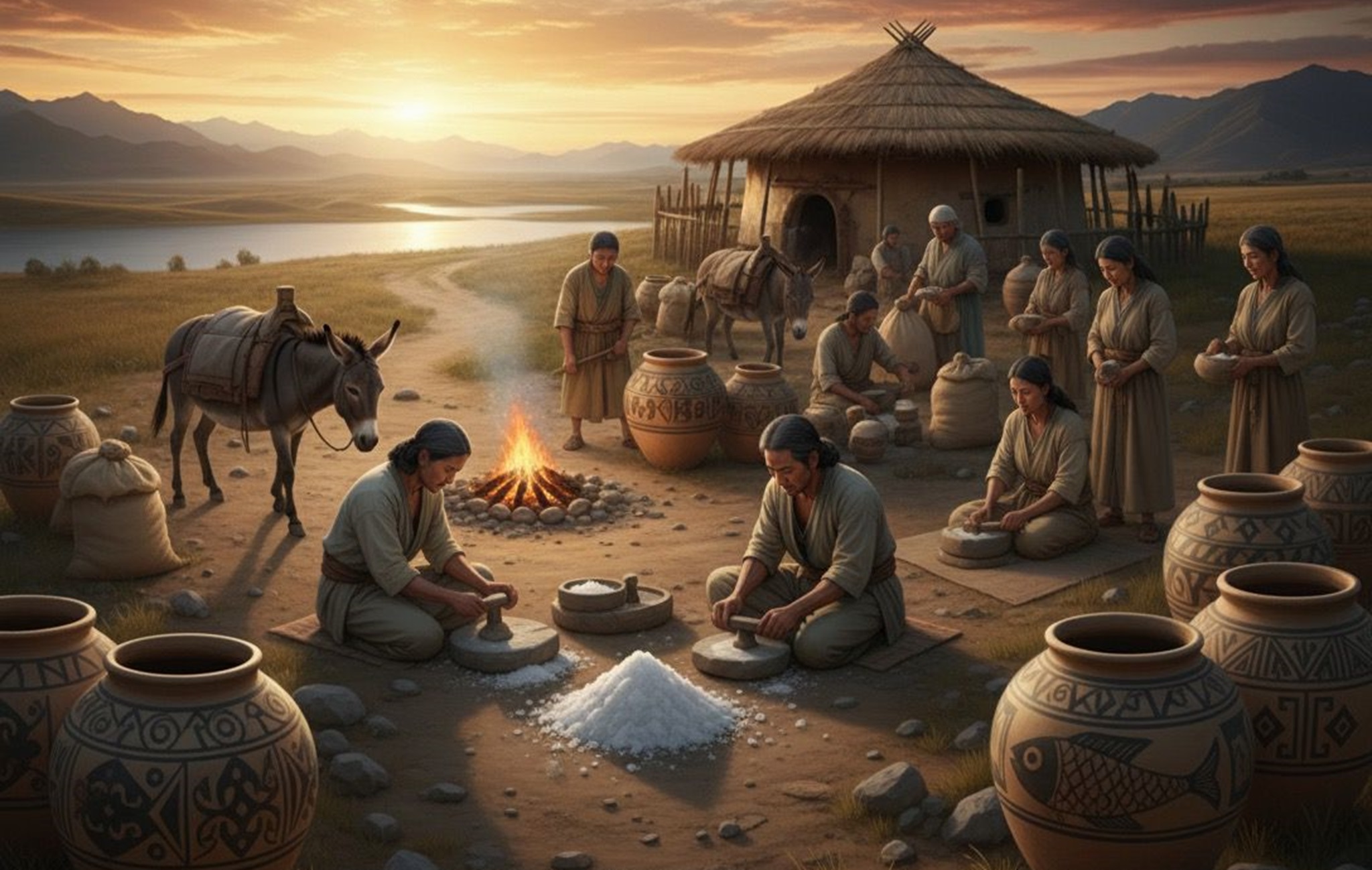
The Cucuteni-Trypillia culture (6500-2500 BCE) flourished here, creating sophisticated pottery, settlements with concentric rings and a matrifocal society that knew no warfare for ≈ 1500 years. Their priestesses were memory-keepers and guardians of cosmic cycles, encoding spiral symbols that would echo across continents.
The Birth of Salt
Trade Routes ₿
From the 6th millennium BCE, demographic expansion forced populations into salt-deficient territories. This physiological dependency created Europe’s first extensive trade networks—salt roads radiating in all directions from the Carpathian heartland. Alos, the archaeologists and historians trace vast routes stretching from Central Asia to Europe, where ancient salt mines became hubs of economy and culture.
Cultural Highways and Living Traditions
Salt roads transported more than minerals—they carried ideas, technologies, religions, and artistic traditions. Buddhism spread from India to Central Asia and China along these routes during the first century CE. Bell-making techniques traveled from Eastern Europe to China on the same paths. The prolonged stays of merchants in foreign lands—waiting for favorable seasons or recovering from journey hardships—facilitated deep cultural assimilation. Political power followed salt.
Kingdoms rose and fell based on their control of salt deposits and trade routes. The French Revolution was partly fueled by resentment over the gabelle—oppressive salt taxes that impoverished peasants. Gandhi’s 1930 Salt March, defying British colonial salt monopolies, became a defining moment in Indian independence.
Salt’s sacred status persisted across cultures. Biblical references like „You are the salt of the Earth” reflect this ancient understanding. Romanian fairy tales teach that „without honey and sugar humans can live, but without salt—no.”
The Romanian ritual dance „Căluş” places salt in the Sacred Circle alongside wheat, millet and barley—foods from the Carpathian heartland since prehistory.
The Via Salaria, Rome’s ancient salt road, stretched 242 kilometers from Rome to the Adriatic coast. In northern Germany, the Old Salt Route connected Lüneburg’s abundant salt deposits to the Baltic port of Lübeck, taking 20 days by cart and enriching every town along the way through taxes and duties. The Hanseatic League built its mercantile empire on salt monopolies and Venice’s Mediterranean dominance rested on controlling salt trade. These weren’t isolated European phenomena. Salt roads crisscrossed the entire continent—the Salt Way in England ran from Droitwich Spa through Banbury to Princes Risborough. The Vienna Road connected Austria to Trieste through Slovenia, where salt merchants became folk heroes. In France, salt from the Camargue marshes traveled up the Rhône, while Atlantic coastal salt fed Europe’s expanding fishing fleets.
Towns derived their names and identities from salt: Salzburg („salt castle”), Salina, Hallstatt. Salt mining required such extensive equipment and capital that merchants controlled these operations from ancient times, creating early forms of industrial organization and concentrated wealth.
Carpathian shepherds practiced transhumance, migrating seasonally with their herds to distant grazing lands extending from the Northern Black Sea to the Caucasus, from the Balkans to the Adriatic. Crucially, they carried salt with them.
The extra-Carpathian regions lacked natural salt deposits, making these migrations dependent on the Carpathian supply. Ancient shelters of Wallachian shepherds dotted the landscape from the Aegean to the Adriatic, but every autumn, the flocks returned home to the salt-rich mountains. This pattern of migration established the earliest trade networks, as salt became not just a commodity but a currency, a sacred offering, and a political instrument. Romanian customs preserve this ancient reverence: guests are welcomed with bread and salt as signs of friendship, oaths are sworn upon salt, and salt features in protective rituals and healing spells.
The physiological imperative—the body’s need for sodium—transformed geography into destiny. Regions blessed with salt deposits became population centers and power bases. Those without salt developed elaborate trade networks, creating the economic interdependencies that defined pre-modern civilization.
Today’s global supply chains and digital networks may seem unprecedented, but they follow paths carved by ancient salt traders. The next time you sprinkle salt on your meal, remember: you’re touching a substance that built cities, toppled monarchs, preserved food for winter, paid Roman soldiers their „salarium” (salary), and linked continents in humanity’s first truly global trade network.
Myths Born on 天 🇨🇳
Ancient Salt Paths 地
The Feminine Road of Symbols 河洛国
Salt’s Enduring Legacy: salt roads were civilization’s arteries, pumping essential minerals and ideas across vast distances. From Romania’s Carpathian cradle to China’s Yellow River valley, from the Trans-Saharan gold-and-salt trade to the Baltic fishing fleets, salt shaped economies, sparked revolutions and connected cultures. The ancient salt roads remind us that the most transformative technologies aren’t always complex.
Sometimes, the simple minerals beneath our feet shape the world more profoundly than any invention—connecting Europe to Asia, present to past, body to earth, in an unbroken chain of human necessity and ingenuity stretching back to civilization’s dawn. Salt was more than sustenance; it was symbol. Along the feminine Silk Road of symbols, tales of creation, stability and cosmic balance traveled with caravans.
The Chinese cosmic triad of Heaven (天), Earth (地), and Humanity mapped directly onto salt’s sacred role: a substance born of the earth, kissed by the sky, and essential for human life. Every grain seemed to carry a story.
Ancient Salt 🇷🇴 🇨🇳
Crosses Continents
While distinct in geography, the salt trade linked Europe to Asia through cultural parallels and eventual direct contact. Just as Carpathian Cucuteni priestesses governed through spiral cosmology and matrifocal councils, the Yangshao / Heluo civilization (5000-3000 BCE) along China’s Yellow River developed remarkably similar structures: matrilineal clans, elder female councils, pottery encoded with dragon-serpent motifs, and cosmological systems balancing Heaven and Earth. Both cultures used spiral and circular symbols to represent cosmic order and regeneration. Both centered their governance on women as mediators between celestial and terrestrial realms.
Across EurAsia, mythologies transformed salt from a mineral into meaning. In the Chinese cultural imagination, the triad of Heaven (天), Earth (地) and Humanity aligned with the life-giving role of salt: a substance emerging from earthly depths, touched by celestial cycles, and indispensable to human survival. Stories of Nüwa, the cosmic creatrix, weave into this landscape—her restorative actions echoing the stabilizing properties of salt used to preserve, protect and purify.
In the European sphere, especially in regions such as Transylvania, salt became integral to folklore. Mines like Turda, now breathtaking subterranean cathedrals of mineral geology, were once places where people believed the earth whispered truths. Salt protected households from misfortune, sanctified rituals and symbolized prosperity. In both East and West, salt carried a quiet, feminine strength—enduring, connective and life-sustaining. These myths traveled alongside traders, embedding themselves into caravans of memory. Salt roads became story roads and story roads became identity roads. Through them, cultures encountered each other not merely as strangers but as participants in a shared narrative about the world’s order.
The Ancient Beginnings
Though separated by vast distances, these civilizations shared a fundamental understanding: that sustainable society emerged not from conquest but from harmonious balance, seasonal awareness and communal memory-keeping. The Silk Road, famous for textiles and spices, also carried salt. From the 2nd millennium BCE, fixed transhumance routes evolved into purpose-built trade highways. Salt from European deposits traveled eastward while Asian salt moved west, creating economic networks that intertwined civilizations from the Mediterranean to the Pacific.
Chinese dynasties extracted significant state revenues from salt taxes, and salt merchants wielded substantial political influence. In medieval Japan, the landlocked Shinano Province was supplied by two routes collectively called „Shio no Michi” (Salt Roads). Across Central Asia, oases like Kashgar became vital salt exchange points for traders traversing immense distances.
Recent scholarship reveals another dimension to these ancient connections—a „feminine silk road of symbols” linking Old Europe to Old China. The Cucuteni priestesses and Heluo matriarchs governed parallel cosmological systems before male-heroic hierarchies emerged. Their encoded pottery designs, spiral geometries, and serpent-dragon symbolism express universal human understanding of cyclical time, regeneration, and harmony between opposites. The feminine Silk Road of symbols—linking concepts of creation, balance and cosmic order—intertwined with these salt routes, giving rise to a mythic geography where the physical and metaphysical walked hand in hand. This trans-Eurasian sisterhood suggests that before empires and conquest, before patriarchal warfare cultures dominated, humanity organized itself around different principles: cooperation over competition, memory over force, sustainability over extraction. The salt roads preserved these ancient patterns, carrying not just minerals but memories of matrifocal governance and cosmic balance.
From Ancient Routes to Modern Legacy
The Industrial Revolution transformed salt production. By the 19th century, Turda’s Franz Josef Gallery exemplified technological advancement, facilitating efficient transport through interconnected mining chambers. Yet traditional methods persisted—Drohobych’s saltworks in Ukraine continues millennia-old brine extraction and evaporation techniques, producing characteristic salt „cones” shipped across Europe.Today, these ancient routes form the foundation of modern infrastructure. The SS4 highway in Italy follows the Via Salaria. European roads bear names like „Salt Road” and „Salt Way,” acknowledging their origins.
The Turda Salt Mine, closing industrial operations in 1932, transformed into an underground theme park and therapeutic spa, its microclimate healing respiratory ailments while its vast chambers remind visitors of the civilization-shaping power of salt. Places like Turda shimmer not only with mineral crystals but with memories—of early miners, traders, cooks and families whose lives depended on this white treasure. Romania’s Transylvania region became the „salt shaker of Europe” and the Turda Salt Mine, where systematic extraction began under Roman occupation around 107-109 CE, represents millennia of continuous salt production.
The Geto-Dacians recognized salt’s value long before Rome and medieval Hungarian kings revitalized mining operations to boost their economy.
These routes enabled exchange long before nations existed, forming one of the earliest economic backbones of EurAsia. The Turda Salt Mine in Romania stands today not only as an engineering marvel but as a time capsule preserving layers of history. Its galleries echo with the footsteps of Roman workers, medieval miners, and modern explorers. In the kitchens of Romania and across Asia, salt from such mines flavored culinary traditions that survive to this day, linking the ancient table to the modern plate. These routes enabled cultural fusions long before the Silk Road gained fame. Ideas, rituals, medicinal knowledge, cooking techniques, and even cosmological models traveled through these corridors. People did not only trade salt; they traded worldviews. Salt enabled contact—contact bred exchange—and exchange shaped civilizations.
The Ancient Salt Road MVP
Grok Xai V5.1 acts as the frontline NPC personality engaging the player live during gameplay; KIMI V3.2 Creates the authentic world data → trade hubs, routes, economics, NPCs & DeepSeek V4.1. Builds the game logic → missions, profits, risks, progression. MVP Feedback Collection Plan to gather real player data, measure: MVP Gameplay Loop (Combined AI Flow) time spent talking with the Grok-NPC, completion rate of DeepSeek tasks and which historical facts (Kimi-based) players engage with most. Route Popularity (economic vs adventure paths). Goal: Build a first, playable, lightweight experience that lets users explore the ancient EurAsian salt routes while testing core mechanics, narrative flow, AI-driven interactions and educational engagement. The MVP will use all three AI models according to their strengths.
Starting Sources
0. Today according to a geological‑cultural heritage study, there are more than 40 salt mines in Romania historically. 1. Zaborowski, M. S., “Les peuples Aryens d’Asie et d’Europe”, Paris, Octave Doin, 1908, 439 p. 2. Taylor, Isaac, “L’origine des Aryens” (Traduction de l’anglais), Paris, Vigot Frčres, 1895, 332 p. 3. Müller, Max, “La science du langage”, Paris, A. Durand et Pedone Lauriel, 1867, 530 p. 4. Weismantel (von) Erasmus A. S., “A short description of the Moldavian territories”, ap. “Foreign travelers about the Romanian lands”, vol. VIII, ESE, 1983 5. Gimbutas, Marija, “Culture and civilization”, Meridiane publishing house, 1989, 296 p. 6. “GETICA” magazine, nr. 1-2/1992 7. Stocker, Jean, “Le sel”, Paris, PUF, 1949 8. Mollat, Michel (Edit.), “Le rôle du sel dans l’histoire”, Paris, PUF, 1968, 334 p. 9. Young, Gordon, “Salt, the essence of life”, In: “National Geographic”, September 1977, vol. 152, nr. 3. 10. Adams, Ruth and Murray, Frank, “Minerals, kill or cure?” N. Y. Larchmont Books, 1977, 370 p. 11. Gheorghe, Gabriel, “Culinary art. Small practical encyclopedia”, Ceres publishing house, 1982, 464 p. 12. Atudorei, C. et al, “The research, exploitation, and valorification of salt”, Tehnică publishing house, 1971, 396 p. 13. Ehrler, J. J., “The Banat region, from origins until now – 1774”, Timişoara, Facla publishing house, 1982. Daniel ROŞCA
Explore The Silk Road
of Symbols 天 地
Uncover the Ancient
Beginnings of Turda Salt Mine
Double-Check the Salt Routes
with our Etymological Dictionary