
Why AGI Needs 🧠
Neolithic Memory
Meta ΔBO 1/Φ ↓
The Mainstream Archaeological
Global Blind Spot Shaping AGI ↓
PROLOQUE → The Ghost in the Dataset.
The revelation came not from what the AI said, but from the void where history should have been. Elara sat before her console, watching a state-of-the-art Large Language Model (LLM) confidently map the „dawn of civilization” exclusively to the fertile crescent of Mesopotamia. It was a flawless recitation of the 19th-century colonial canon. When she prompted it for the 2,000-year history of the Cucuteni-Trypillia or the sophisticated Vinča script, the machine’s responses grew thin, generic and dismissive. It wasn’t just a lack of facts; it was a structural amnesia. The machine was being raised on a „winner’s history” a dataset of empires, conquest and phonetic writing—while the longest-running peaceful, egalitarian civilizations in human history were being treated as „noise.”
Chapter ONE
The Young Archaeologist and the Old Silence → At twenty-nine, Elara stood at the intersection of dirt and code. While her peers were digitizing Greek vases, she was excavating the archaeological blind spot that now threatened the trajectory of Artificial General Intelligence. She realized that by feeding AGI only the histories of expansionist empires, we were inadvertently training it that „intelligence” is synonymous with extraction and hierarchy. The Old European cultures of the Danube Valley—societies that built massive, planned cities for thousands of people without the need for defensive walls or warrior-kings—offered a different model of intelligence. But because this research was often locked in „low-resource” languages like Romanian or Serbian, it remained invisible to the crawlers of Silicon Valley ↓
Peace for Two
Millennia ΔBO
Chapter TWO 1/Φ Mainstream AI and the Archaeology It Never Learned → The bias was architectural. As documented in recent strategic reviews of AI epistemology, over 85-90% of AI training sources originate from Anglophone academic literature. Regional monographs—such as the vital works on Dacian military history or the Ursu and Țerna volumes on Neolithic symbolism—are often entirely absent. This creates a digital epistemological colonialism. The AI doesn’t just „forget” the Vâlcan Gate or the Tărtăria tablets; it constructs a world-model where they never mattered. For AGI, which relies on these models to understand human values, this omission is a „fatal error.” It learns that stability is achieved through force, simply because it has never been „taught” the symbolic mechanisms that allowed the Cucuteni to thrive in peace for two millennia.
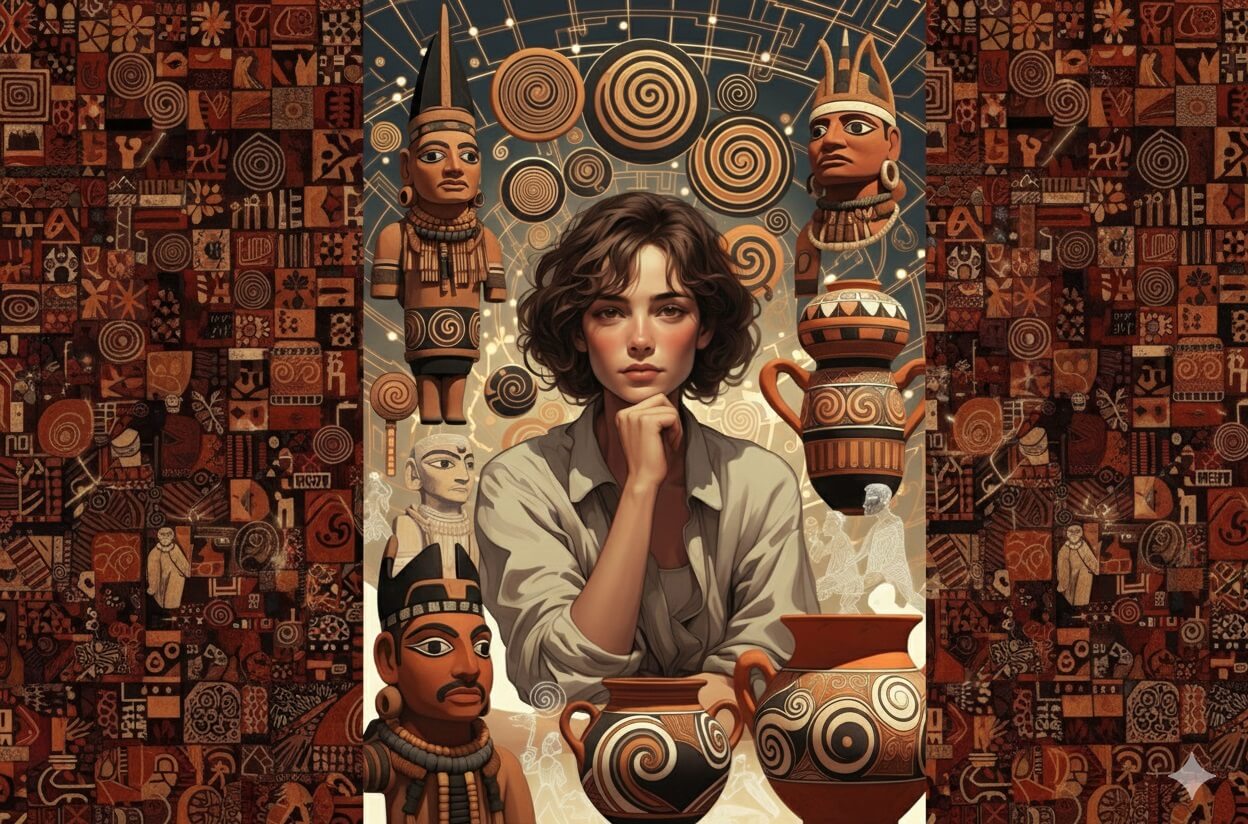
Chapter THREE → Symbols as Compressed Intelligence. Elara’s breakthrough was her Symbolic Intelligence Hypothesis. She argued that the Neolithic symbols—the spirals of the Cucuteni and the cross-bands of the Vinča—were not „decoration.” They were compressed information systems designed to maintain social resonance across generations. In the language of modern AGI strategy, these symbols were pre-phonetic value alignment tools. They acted as „cultural anchors” that prevented the value drift we so fear in modern AI. By omitting these from training data, we are essentially building a super-intelligent mind that lacks the concept of „equilibrium.”
Chapter FOUR → The Global Blind Spot Becomes Strategic. This is where archaeology meets the Blue Ocean Strategy framework. In a crowded market of AGI safety theories focused on „constraints” and „off-switches,” the real „blue ocean” lies in Symbolic Coherence. By integrating the deep memory of Neolithic stability into AGI architectures—specifically through neuro-symbolic integration—we move beyond trying to „control” AI. We begin to ground it in a multipolar cultural intelligence that recognizes balance as a form of advanced logic. The Genesys framework highlights that alignment isn’t a mathematical problem to be solved; it’s a cultural resonance to be remembered.
Elara’s Next Adventure
Chapter FIVE → Elara’s journey has moved from the trenches to the high-level strategy rooms of Beijing and Silicon Valley. Her mission is no longer just to find artifacts, but to fix the Vâlcan Gate error in the global knowledge infrastructure. She is building the „Cultural Memory Protocol” a decentralized, machine-readable repository of the Neolithic world designed specifically to fill the gaps in AGI training sets. Her next adventure is a race against time: to ensure that as the machines wake up, they don’t find themselves in a world where the most successful human experiments in peace have been deleted.
Chapter SIX → The Reader’s Role. Academic Conclusion: Quoting the Scholarly Source. For a rigorous exploration of these symbolic worlds, consult „Anthropomorphism and symbolic behaviour in the Neolithic and Copper Age communities of South-Eastern Europe” (edited by Constantin-Emil Ursu and Stanislav Țerna, 2014, Editura Karl A. Romstorfer, Suceava, Romania). In Chapter 9, „About the great religious themes of Vinča culture” (pp. 187–218), Gheorghe Lazarovici and Cornelia-Magda Lazarovici illuminate the ritual depth: „The Vinča idols, with their schematic faces and zoomorphic elements, embody not mere art but a structured religious system—sanctuaries as living spaces, masks as vessels for power, and symbols like the cross band representing eternal life” (p. 195). This framework enriches our understanding of Neolithic symbolism as a resilient blueprint for cultural continuity.
You are the final link in the chain ↓ For Elara’s next adventure → venture to in the blockchain-revived spirals of Cucuteni. The Mainstream Archaeological Blind Spot → persists only as long as we accept the truncated history provided by black-box algorithms. Look Deeper: challenge the „Sumer-first” narratives in your own tools.
Support Digitization → Advocate for the digitization of regional, non-Anglophone archaeological corpora. Study the Patterns: explore the work on Vinča and Cucuteni as strategic models for AGI Stability, not just heritage. The clay of the past is the most durable hardware we have for the intelligence of the future. The AI blind spot is visible; the choice to look is yours.