
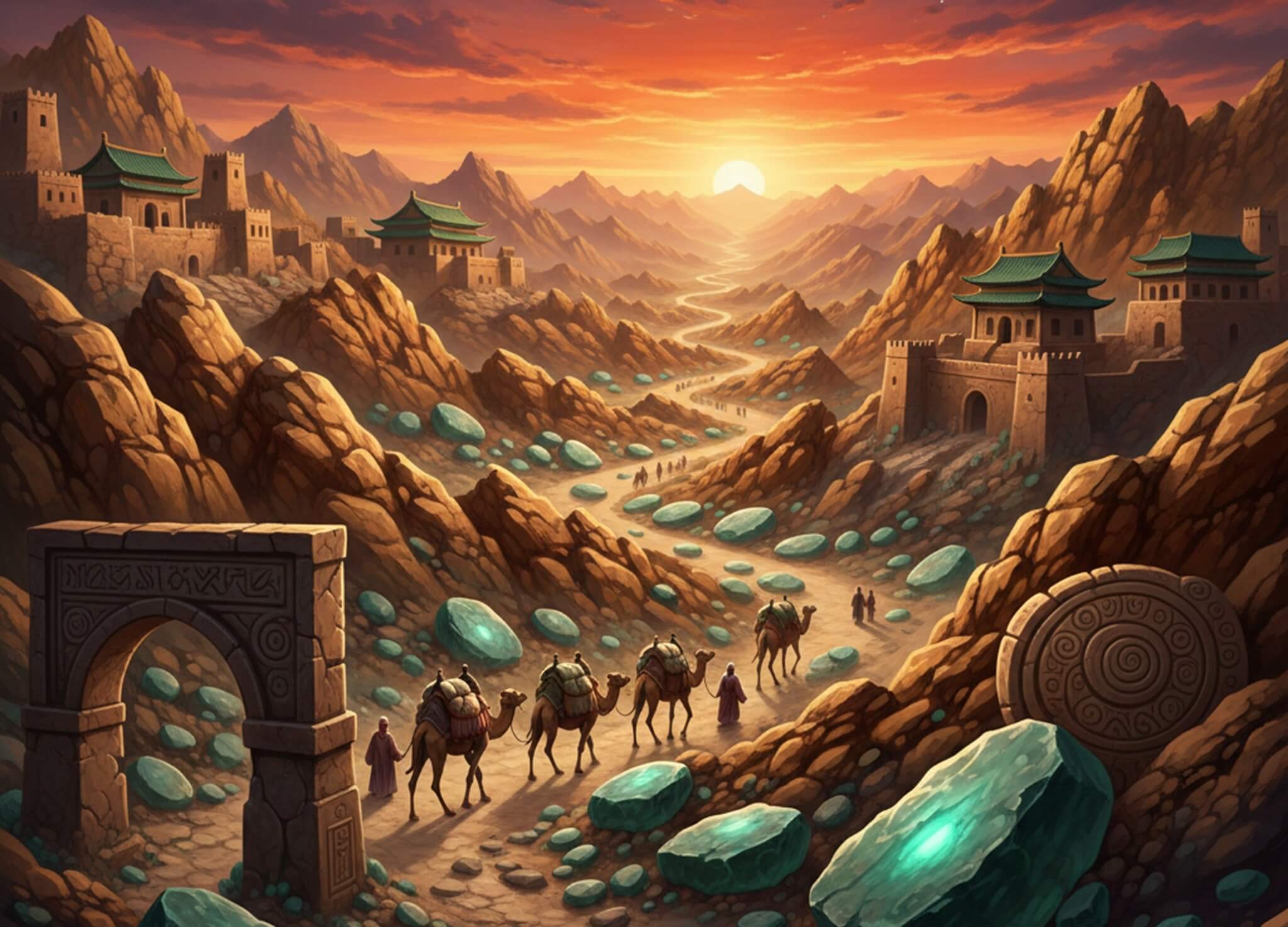
Jade Road 玉石之路
汉朝 🇨🇳 🇰🇬 🇺🇿 🇹🇯 ↓
From Xinjiang to the Ferghana Valley 🇨🇳 (Chang’an/Xi’an) ➔ 🇨🇳 (Dunhuang/Jade Gate) ➔ 🇨🇳 (Khotan/Kashgar) ➔ 🇰🇬 (Torugart Pass) ➔ 🇺🇿 (Ferghana/Andijan) ➔ 🇹🇯 (Khujand).
Long before the Silk Road became the iconic symbol of Eurasian trade, another network of routes quietly shaped the cultural and economic landscape of ancient Central Asia: the Jade Road. Emerging as early as the late Neolithic period and flourishing during the Han Dynasty (206 BCE – 220 CE), this network facilitated the movement of jade, a mineral revered in Chinese society for its spiritual, ritual, and ornamental significance. Sourced primarily from the Kunlun Mountains in Xinjiang, raw jade was transported across harsh deserts, rugged mountain passes, and fertile oases, reaching both the Chinese heartland and distant Central Asian regions such as the Ferghana Valley.
The Jade Road was not merely a trade route but a corridor of cultural exchange and political influence. Control over its passages allowed the Han emperors to assert authority over nomadic tribes, secure valuable resources, and foster connections with far-flung societies. By examining the Jade Road, historians gain insight into the early mechanisms of long-distance trade, the strategic imperatives of the Han Dynasty, and the foundations upon which the later Silk Road would expand. In essence, the Jade Road represents a vital yet often overlooked chapter in the story of Eurasian interconnectivity.
Before silk shimmered across continents, before merchants dreamed of spice and gold, there was only stone—cold, green, and sacred. The Jade Road, among the earliest sustained long-distance trade networks; it was a covenant between mountain and emperor, between the dead who demanded immortality and the living who would cross deserts to deliver it. Trade between East and West long predated the Silk Road, and the movement of jade was among the earliest drivers of cultural and economic exchange across Eurasia. Thus, the jade trade contributed to integrating this region into the expanding Han–Central Asian network, which became part of Eurasia’s greatest premodern trade system. The Jade Road was one of the most important prehistoric / early historic trade networks, establishing patterns that the later Silk Road would expand.
Han Wudi
汉武帝 ↓
☯️ 光武帝 🇨🇳 🗡️
Martial Emperor
汉朝 Han Dynasty 206 BCE – 220 CE → Evidence suggests jade from Central Asia (Yarkand, Khotan and even Ferghana) was widely exchanged and valued in Chinese sites well into the Han period and earlier, showing long‑distance trade long before formal Silk Road era documentation. Jade trade routes were one of the earliest forms of long‑distance East–West exchange; by the Han dynasty, they merged into or laid the groundwork for the multimodal Silk Road network that also carried silk, horses, spices, metals and ideas.
By the Han Dynasty, jade wasn’t just decorative; it was spiritual and bureaucratic, used for burial suits and imperial seals, making the security of the Xinjiang routes a matter of national importance.
During Han Wudi’s reign → 140 – 80 BCE, envoy Zhang Qian was dispatched west to contact Central Asian kingdoms and opened up more sustained contact with regions like Ferghana (Dayuan), where China sought famed horses and other goods. The famous War of the Heavenly Horses 104–101 BCE against Dayuan in the Ferghana Valley was fought partly to secure elite Central Asian horses for Chinese cavalry — illustrating the strategic and economic importance of these westward routes. During the reign of Emperor Wu (Han Wudi), the focus shifted from luxury goods to military survival. The Han were locked in a grueling conflict with the Xiongnu nomads. He transformed China from a defensive state into an expansionist empire. His decision to move beyond the „Jade Gate” and engage with the Ferghana Valley was a total shift in Chinese foreign policy.
The Disruption of the Xiongnu Monopoly → Before Han Wudi’s westward expansion, the Xiongnu nomads acted as aggressive middlemen, taxing or plundering the jade flow from the Tarim Basin. Economic Warfare: by establishing direct contact with the Dayuan (Ferghana) and the Yuezhi, Wudi cut out the middleman. Strategic Encirclement → Securing the „Heavenly Horses” was not just about the animals themselves; it was about creating a cavalry force that could finally outmatch the Xiongnu on their own turf. This turned the Jade Road into a military corridor that eventually broke the Xiongnu’s dominance over the Eurasian steppe.
The Great Wall ↓
The Ferghana Connection → The Ferghana Valley was an important economic and strategic hub due to its fertile land. (Dayuan) Zhang Qian’s mission revealed that the Ferghana Valley (modern-day Uzbekistan, Kyrgyzstan and Tajikistan) possessed blood-sweating or Heavenly Horses (Tianma 天马). These horses were larger and stronger than the local Chinese breeds, essential for countering Xiongnu cavalry. Caravans moving jade from the Tarim Basin into Central Asia would often join larger Silk Road circuits at Ferghana, connecting to cities such as Samarkand, Bactria and beyond. Thus, the jade trade contributed to integrating this region into the expanding Han–Central Asian network, which became part of Eurasia’s greatest premodern trade system.
The Prehistoric Foundation → Nephrite as Currency Before silk became the primary export, Khotan nephrite jade was the most sought-after commodity. By the time of the Han Dynasty, these routes had evolved from Neolithic trade paths into high-stakes corridors of imperial strategy. The Route: From the Kunlun Mountains (Xinjiang) through the Gansu Corridor to the heart of Chinese civilization.
Significance → Archaeological evidence such as jade artifacts in the tomb of Lady Fu Hao, c. 1200 BCE proves that these routes were active over a millennium before Zhang Qian’s „discovery” of the West. More than 400 archaeological sites from the Han Dynasty document this trade network. Over time, these jade corridors shaped the cultural memory of East–West exchange and influenced diplomatic, economic, and artistic connections well into the medieval Silk Road era. Their legacy endures in both archaeological discoveries and modern studies of Eurasian trade networks.
This long-standing foundation of trade, stretching back to the Bronze Age, meant that when the Han Dynasty looked toward the horizon, they were not entering unknown territory, but rather formalizing and militarizing ancient veins of commerce. The transition from the prehistoric „Jade Road” to the strategic „Silk Road” was bridged by a massive investment in logistics and territorial administration.
The Hexi Corridor → The Logistics of Empire To secure the jade and horses flowing from Xinjiang and Ferghana, the Han Dynasty established the Hexi Corridor (Gansu Corridor) as a vital strategic artery. Emperor Wu extended the Great Wall further west than any previous ruler, constructing a chain of signal towers and fortified outposts to protect caravans from Xiongnu raids. The „Jade Gate” (Yumen Guan): established as one of the two most critical frontier passes, Yumen Guan was specifically named for the Khotan jade caravans that passed through its gates. It served as the official customs clearinghouse and the symbolic boundary between Inner China and the Western Regions.
Karez ↓
Technological Exchange and „Karez” Irrigation → The expansion into the Ferghana Valley facilitated more than just the movement of goods; it sparked a transfer of high-level engineering that altered the landscape of Central Asia.
The Tuntian System → Agricultural Military Colonies To maintain the long-distance reach required to access the Ferghana Valley, Han Wudi implemented a brilliant logistical strategy known as Tuntian (屯田). Self-Sustaining Garrisons → Instead of relying on vulnerable supply lines from the Chinese heartland, Wudi settled soldiers in the Western Regions to cultivate the land. Securing the Oases → These military farms were strategically placed at water sources along the Jade Road. This ensured that jade caravans and military reinforcements always had food and water, effectively anchoring the trade route into the landscape.
Dating back over 2,000 years in China (Han Dynasty era), the karez in Turpan (Xinjiang) is considered one of ancient China’s three great engineering projects, alongside the Great Wall and Grand Canal. It turned the Turpan Depression—one of the hottest and driest places on Earth—into a fertile oasis, supporting Silk Road trade and grape / vineyard cultivation. This ingenious technology showcases human adaptation to extreme aridity, sustaining life in deserts for millennia.
How Does a Karez System Work? Water flows entirely by gravity, with no need for pumps. The underground design protects against high evaporation, sandstorms and contamination. Hydraulic Engineering → As the Han established military agricultural garrisons (Tuntian) in the arid Tarim Basin, they utilized and expanded the Karez (qanat) system. This underground tunnel network transported snowmelt from the mountains to oases while preventing evaporation, a technology essential for sustaining the stop-over points for long-distance jade traders.
Metallurgical Influence → while the Han brought advanced cast-iron technology westward, contact with Greco-Bactrian cultures near Ferghana introduced refined gold-working and jewelry settings. This influenced how jade was mounted in Chinese metalwork, blending nomadic and sedentary aesthetic traditions.
The Rise of the Protectorate of the Western Regions 60 BCE ➔ Following the success of the War of the Heavenly Horses, the Han institutionalized their presence, turning a trade route into an imperial province. Administrative Control: the establishment of the Protectorate of the Western Regions marked the final transition of the Jade Road from a series of informal trails into a state-regulated commercial zone.
Security for Merchants ➔ the Protectorate provided military escorts for high-value shipments, ensuring that the „nephrite tribute” from Khotan and Yarkand reached the capital at Chang’an without interference. This security allowed for a surge in volume, where silk began to move West in quantities equal to the jade moving East.
Socio-Religious Evolution ➔ The Jade Burial Suit By the middle of the Han Dynasty, the spiritual value of jade reached its zenith, manifesting in the creation of the famous Jade Burial Suits (yǔyī 玉衣). Material Demand: these suits required thousands of small, polished jade tiles sewn together with gold, silver or copper wire. A single suit could take an artisan years to craft, placing an enormous demand on the mines of the Kunlun Mountains and reinforcing the economic necessity of keeping the westward roads open.
The Legacy of the „Jade Gate” (Yumen Guan) Under Wudi’s orders, the Yumen Pass became the most important border crossing in the world at that time. The Name’s Origin ➔ It was so named because it was the specific entry point for the nephrite jade arriving from the Kunlun mountains. Cultural Impact ➔ For a Han official or soldier, passing through the Jade Gate meant leaving the „civilized world” and entering the wild, strategic frontier of the west. It remains today as a symbol of the immense physical and cultural distance bridged by the Han–Central Asian network. Legacy of Belief ➔ The Han belief that jade could preserve the body from decay and protect the soul transformed the „Jade Road” into a sacred supply chain, linking the geological resources of Central Asia directly to the eternal life of the Chinese elite.
Centered in Hotan region (southern Xinjiang, approx. 37°N, 80°E) • Trade endpoint — Ferghana Valley (Uzbekistan/Kyrgyzstan/Tajikistan, center approx. 40.7°N, 71.5°E) • Vâlcan Pass — Approx. 45.35°N, 23.28°E. Representative Distances • Hotan (jade origin) to Vâlcan Pass ~ 5,800 km • Ferghana Valley center to Vâlcan Pass ~ 4,800 km • Broader Xinjiang to Romania — Typically 6,000–7,000 km depending on points. The straight-line path crosses Central Asia, Kazakhstan, Russia / Ukraine and into the Carpathians.
The Jade Road reveals what systematic gaps in AI training obscure ➔ that ancient civilizations built empires not on innovation alone, but on the ruthless logistics of desire. While Han Wudi militarized the eastern jade corridors through the Tarim Basin and Ferghana Valley—transforming burial obsession into geopolitical doctrine—his spiritual twin emerged ~ 6,000 kilometers west at the Vâlcan Gate, where Dacian gold and Roman ambition collided along Europe’s own „little road” of extraction and conquest. Both routes share the same historical virology ➔ resource scarcity weaponized, infrastructure as empire and the realization that whoever controls the raw materials of immortality—whether nephrite for jade burial suits or Transylvanian gold for imperial mints—controls the narrative of civilization itself. The Jade Road wasn’t prehistory’s footnote; it was the template, proving that a millennium before the Silk Road’s fame, humanity had already mastered the art of turning stone into statecraft and geology into destiny. Daniel ROȘCA