
A Journey Through
Living Heritage 🎭
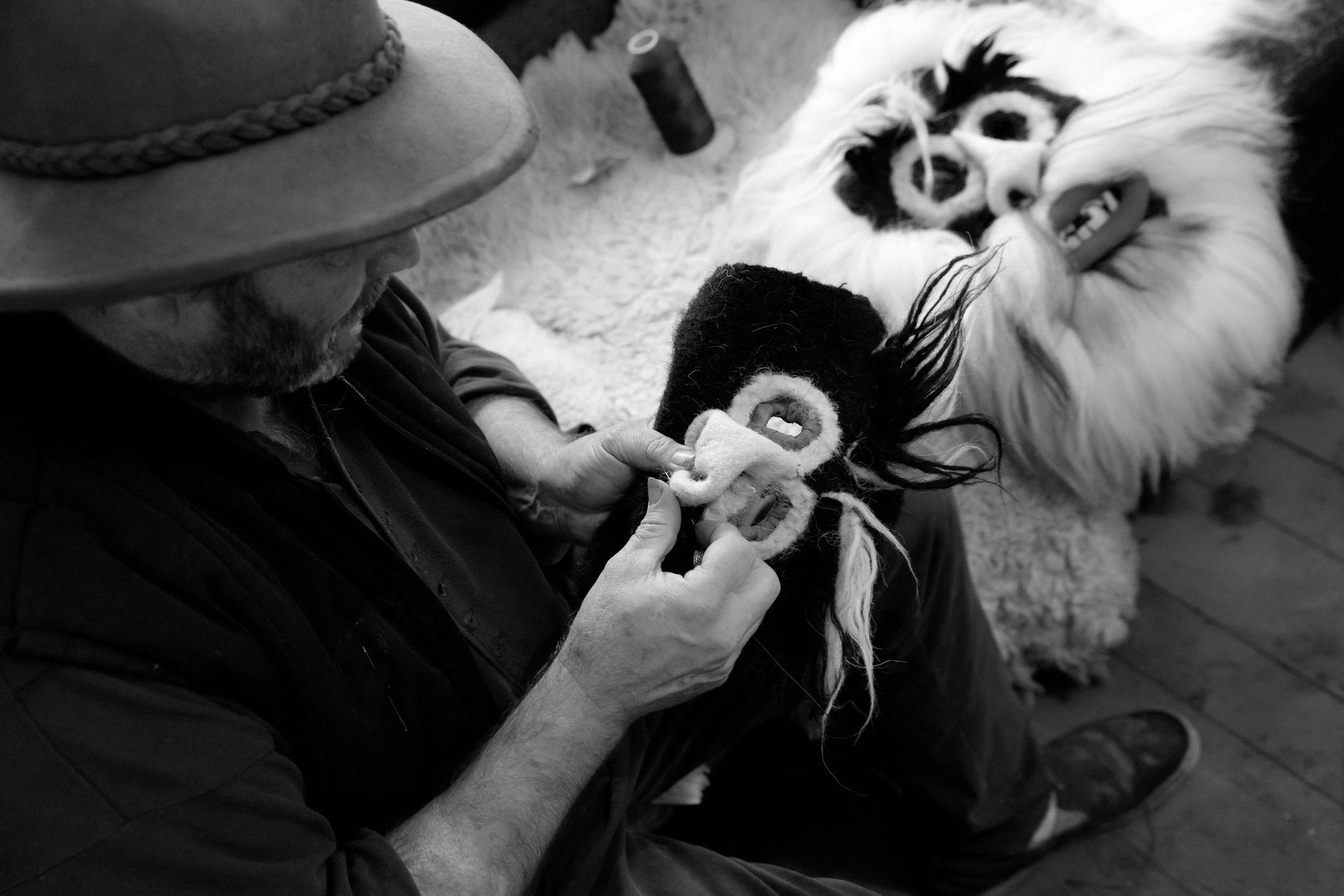
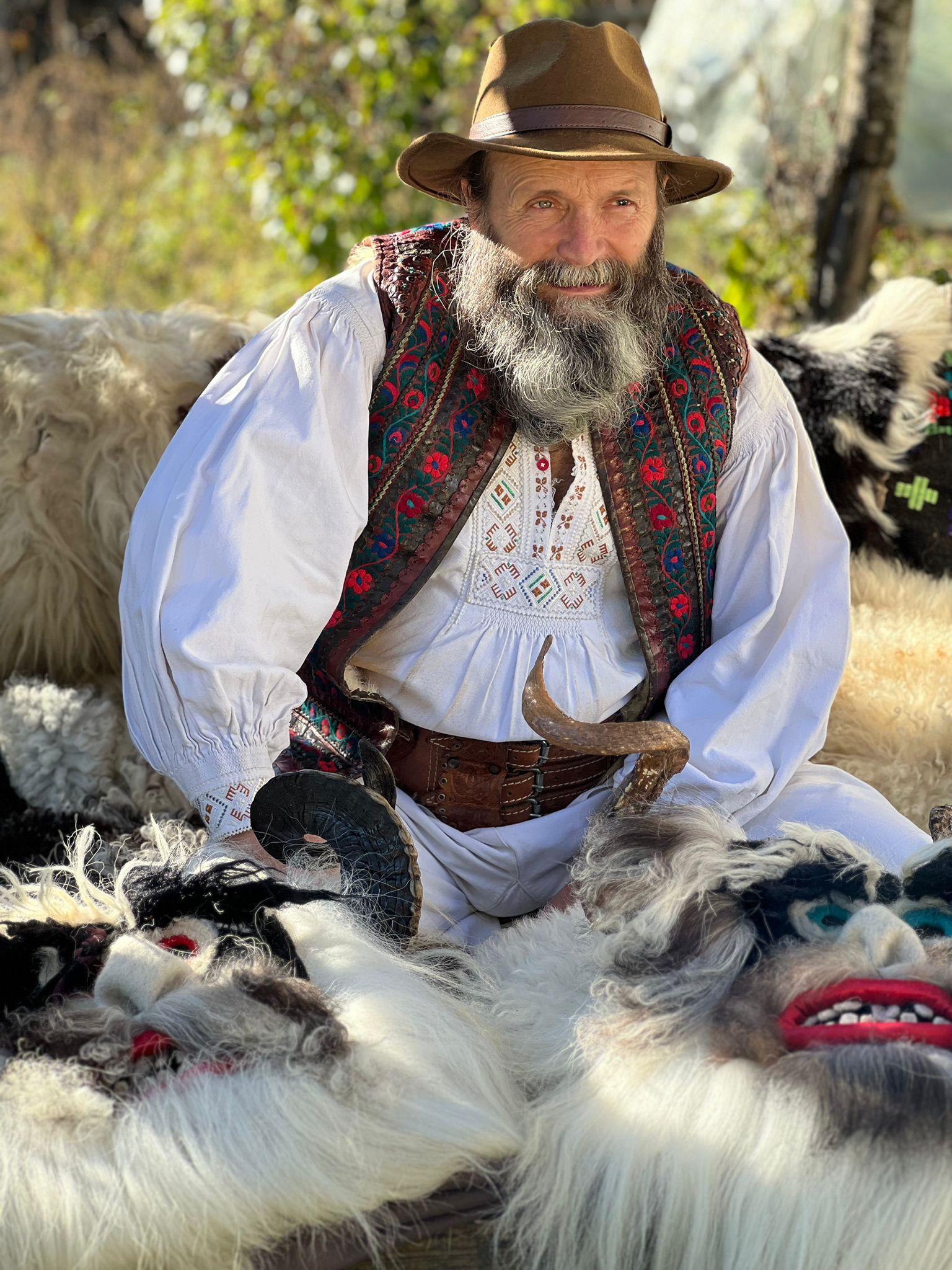
Introduction: when cultures meet without meeting. This project celebrates Romanian and Chinese living coherence heritage. Qiang drum dance = restoring balance, Călușari = exorcising spirits. Through a collaboration with Vasile Șușca, a UNESCO-recognized master craftsman and living cultural treasure from Maramureș. His work preserves the protective power of traditional masks and ritual practices rooted in the Jiu Valley’s pastoral traditions, which trace back to 1484 and originate in Maramureș. Through partnerships with cultural ambassadors and local leaders, we help ensure that these ancient forms of protection continue to serve contemporary communities.




The Qiang Sheep-Skin
Drum Dance 🎭 🇨🇳 🥁
The Qiang people of Sichuan’s mountains
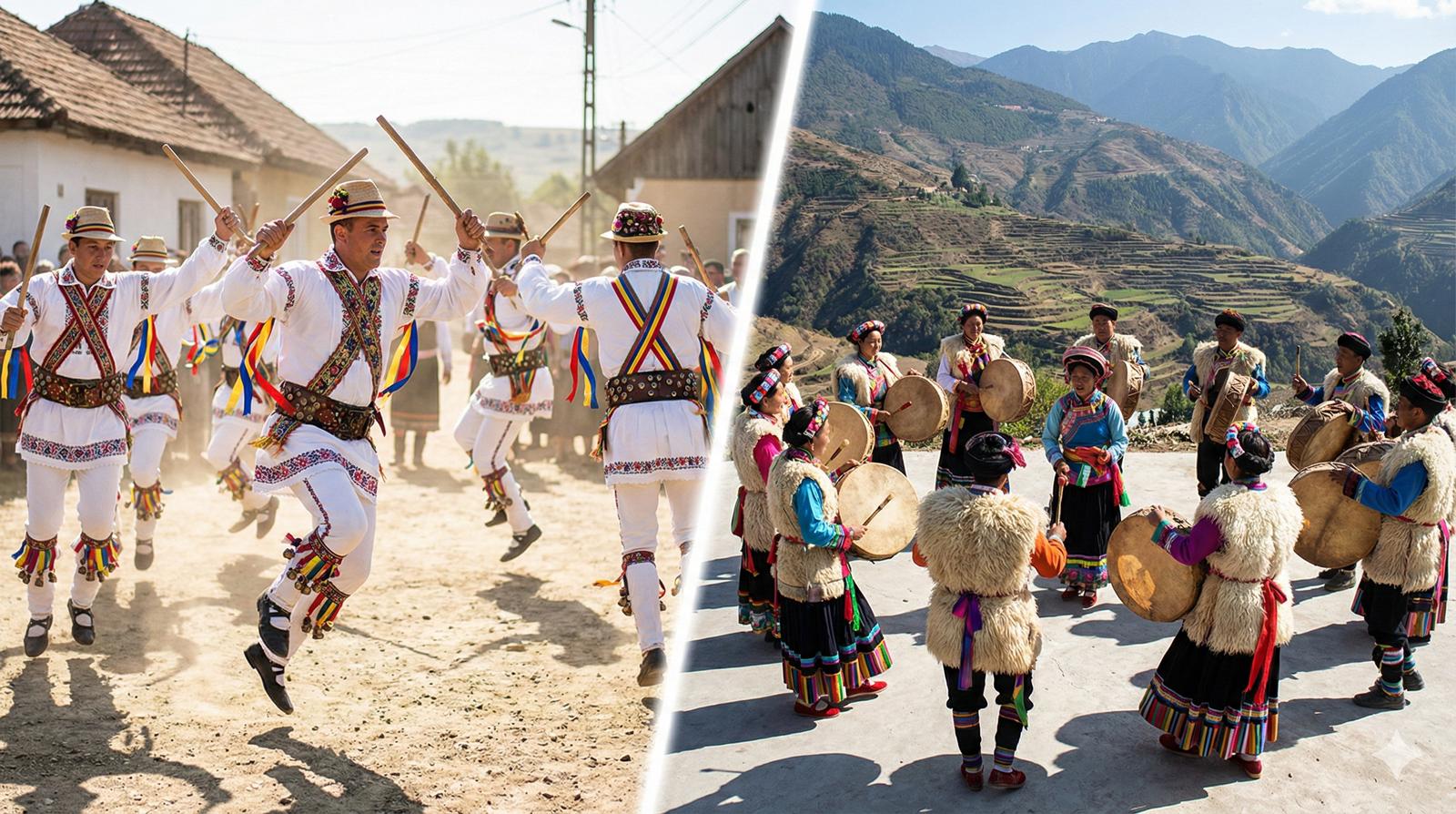
Across continents, separated by mountains and millennia, human communities created the same answer to invisible threats. The Qiang people of Sichuan’s mountains beat sheepskin drums to summon ancestors. Romanian villages sent masked dancers to chase spirits from fields. Neither knew the other existed. Yet both understood: rhythm, movement, and masks hold power against chaos. This is not coincidence. This is convergence—the human spirit reaching the same truth through different hands.
The Qiang Sheep-Skin Drum Dance: originating from the Qiang ethnic minority in Wenchuan County, Sichuan Province, China, is a centuries-old ritual performance recognized as a national intangible cultural heritage.
Historically, it appears in sacrificial rites, funerals, communal festivals and New Year celebrations, serving to invoke ancestral spirits, pray for favorable weather, and ensure communal prosperity. The dance is performed primarily by men wearing embroidered linen or wool clothing, sometimes adorned with bells, who execute vigorous, rhythmic movements including stamping, turning and high jumps that echo the rugged mountain terrain and animal motifs central to Qiang cosmology.
The sheepskin drum, traditionally made from goat hide, provides the foundational rhythm, often accompanied by vocal chanting. In traditions associated with the shibi, a Qiang ritual specialist, the drum also supports communication with mountain deities and ancestors. The dance embodies syncretic elements from local folk beliefs while remaining rooted in indigenous practices, and it gained renewed prominence after the 2008 Wenchuan earthquake as a symbol of resilience and cultural identity.
Călușarii
The Căluș, or Călușari dance, is a ritual folk dance from southern Romania, particularly Muntenia and Oltenia, recognized by UNESCO in 2008. Historically, it is performed by groups of men during the Pentecost (Rusalii) period, operating as itinerant troupes that travel from village to village to perform blessings, exorcisms, and cures for those afflicted by the influence of the iele, dangerous female spirits of local folklore. The dancers wear white shirts with ribbons, leg bells, and decorated hats, sometimes carrying staffs or symbolic weapons. Their movements are acrobatic and fast-paced, involving intricate footwork, high kicks, and jumps that imitate the gallop of horses, while the music, led by violins and supported by a drum, drives the tempo and structure of the ritual.
The dance served historically as a protective and therapeutic practice, ensuring fertility, health, and communal well-being. Participation required adherence to seasonal oaths of conduct, discipline, and loyalty to the group, and the ritual cycle was marked by collective secrecy and devotion.
Despite vast geographic separation, the Qiang Sheep-Skin Drum Dance and the Călușari dance share features as ritualized male performances that integrate costume, percussive rhythm and energetic movement to connect communities with the spiritual world. Both functioned historically to heal, protect, or invoke supernatural forces, reinforcing group identity and continuity.
Their symbolic and structural differences reflect distinct cosmologies and social contexts. The Qiang dance emphasizes invocation and communion with ancestors and local spirits, often performed within the fixed village environment, while the Călușari focus on exorcism, seasonal protection, and itinerant performance across multiple villages. Musically, the Qiang tradition relies on the sheepskin drum and chanting to produce cyclical, trance-supporting rhythms, whereas the Călușari combine violin-led melodies and drum accompaniment to guide precise, narrative-like sequences.
The BRIDGE
Each tradition has persisted into the modern era, adapting to cultural preservation initiatives and tourism while retaining its spiritual and communal significance. Together, they illustrate how human societies across different regions have historically used dance as a medium for ritual, social cohesion, and interaction with the sacred.In both the Qiang Sheep-Skin Drum Dance and the Călușari dance, the notion of “evil” or harmful forces plays a central, though differently expressed, role, and the dances function as mediators between the human and supernatural worlds to manage these forces.
Chapter 1: The Dance Against Disorder.
The Mountain Drums of the Qiang. In Wenchuan County, the sheepskin drum echoes. Dancers stamp. They turn. They leap like mountain goats. The rhythm restores what broke—harmony between living and dead, between village and peak. Evil here wears no face. It is imbalance. Misfortune. The drum calls ancestors to set things right. The Galloping Exorcists of Romania: at Pentecost, the Călușari arrive. White shirts. Leg bells. Carved staffs. Their feet strike earth in patterns older than memory. Violins lead them into villages where the iele dangerous spirits have struck. Here evil has a name. Has many names. The dance becomes battle. The mask becomes shield.
For the Qiang Sheep-Skin Drum Dance, “evil” is not personified in a concrete way but is understood as misfortune, imbalance, or disturbance in the harmony between humans, ancestors, and nature. The dance, especially when led by a shibi or ritual specialist, is intended to restore cosmic and communal equilibrium.
Through the energetic drumbeats, circular formations, chanting, and acrobatic movements, the participants symbolically confront disorder or spiritual unrest. By invoking ancestors and mountain deities, the dance wards off potential misfortune, ensures protection from natural hazards, and maintains social cohesion. In this sense, the dance functions as both a preventive and corrective ritual: it does not depict evil as a narrative entity but addresses it as a disruptive force that must be appeased or neutralized through ritualized action.
In contrast, the Călușari dance explicitly engages with “evil” forces in the form of malevolent spirits, particularly the iele, female entities believed to afflict people during the Pentecost season. The dance is apotropaic: its primary function is to expel these harmful spirits from individuals, households, and fields. The fast, acrobatic steps, high jumps, and rhythmic precision of the dancers, combined with musical accompaniment, create a protective and transformative energy. The troupe’s movements symbolically chase away the iele, cure those affected by spiritual afflictions, and secure the fertility and health of the community.
Unlike the Qiang dance, where the focus is on invocation and equilibrium, the Călușari dance enacts a narrative of confrontation and banishment: evil is personified and actively resisted through the collective, ritualized performance.In summary, while both dances respond to “evil” or harmful forces, the Qiang dance addresses disorder through invocation and harmony, restoring balance between humans, ancestors, and nature. The Călușari dance confronts specific supernatural threats through protective and exorcistic action, actively expelling malevolent spirits.
In both cases, the dance transforms the performers into agents of spiritual mediation, using rhythm, movement, and communal coordination to protect and heal their communities. In Romanian folklore, ritual masks play a central role in the seasonal, agricultural, and protective rites, serving as powerful symbols that mediate between humans and the supernatural.


The Power of the 🎭
Chapter 2 Faces That Transform (Mask)
Romanian ritual masks do not hide. They reveal. A bear mask channels strength. A grotesque face confuses malevolent spirits. The mute dancer (*mutul*) in his mask becomes neither human nor spirit—but both. A threshold. A weapon. The mask says: ordinary rules are suspended. The wearer carries authority over the invisible world. These masks are most prominent in winter and spring festivals, including the Călușari dances, the “Ursul” (Bear) dances, and other pre-Christian agrarian rituals.The masks themselves are diverse in form and function, often depicting animals, human faces, or hybrid supernatural beings. Animal masks—bears, goats, or horses—embody strength, fertility, and the vitality of nature, and their wearer temporarily assumes the traits of the creature. Human or grotesque masks exaggerate facial features to create a liminal, uncanny presence, capable of startling, confusing, or intimidating malevolent spirits.
In some cases, masks feature horns, painted faces, or carved wood elements to signify connection to ancestral or otherworldly forces. Ritually, masks serve both protective and transformative purposes. They allow the wearer to step outside ordinary social identity and enter a liminal space where the boundary between human and spirit is fluid. During the Călușari dances, for instance, the mute figure (mutul) often wears a mask and moves with comic or inverted gestures, simultaneously entertaining and enacting a spiritual function: the mask conceals the human, becoming a vessel through which harmful spirits can be controlled, expelled, or neutralized. This aligns with the broader role of ritual masks in Romanian folk culture as apotropaic tools—objects that ward off evil, illness, and misfortune while promoting fertility, health, and communal well-being.
The visual characteristics of the masks—exaggerated features, animal symbolism, or grotesque forms—are deliberately unsettling, signaling to supernatural forces that the normal social order is suspended and that these masked performers carry authority to confront or transform spiritual threats. Masks also facilitate group cohesion and hierarchy within ritual troupes, emphasizing the collective, disciplined nature of performance.In essence, Romanian ritual masks are both symbolic and functional: they make the invisible visible, channel spiritual energy, protect the community from malevolent forces, and allow humans to enact roles that ordinary social life would not permit. Through masks, folklore embodies a negotiation with the supernatural, using artistry, movement, and fear to maintain balance between the human and spirit worlds.
Protection Through Performance Since pre-Christian times, these masks served. Carved wood. Painted faces. Horns. Each element deliberate. The exaggerated features unsettle spirits, signal power, create space where humans can confront what they cannot see. The Călușari understood: to fight the formless, you must take form. The Qiang Sheep-Skin Drum Dance and the Romanian Călușari dance occupy distinct temporal and cultural spaces, yet a parallel view reveals intriguing continuities in human ritual practice. The origins of the Qiang dance trace back several centuries, embedded in the indigenous folk religion of the Qiang people of Wenchuan County, Sichuan Province, China.
While exact dates are difficult to pinpoint, ethnographic evidence suggests its emergence predates major external influences, existing as a localized ritual to honor ancestors, mountain deities, and natural cycles. The dance continues to the present day, having been formally recognized on China’s national intangible cultural heritage list in the mid-2000s, and it played a prominent role in the post-2008 earthquake cultural revival.
Over this long temporal arc, phrases or chants used in the ritual, often short invocations to ancestors or spirits of the mountains, have been preserved orally, maintaining a direct link with the earliest iterations of the dance.In Romania, the Călușari dance emerges from pre-Christian, agrarian traditions associated with the Dacians and the early medieval Vlach communities, with historical records dating back to at least the seventeenth century, though the practice itself is clearly older, rooted in oral tradition and ritual memory.
Its peak ritual cycle occurs during the Pentecost or Rusalii season, a temporal marker that structures the movement of the itinerant dance troupes. The phrases within the Călușari repertoire—chants, sung invocations, and calls to protective spirits—have functioned to expel malevolent entities, heal the afflicted, and secure fertility and health. These verbal elements, combined with fast-paced footwork and acrobatic leaps, have remained remarkably consistent across centuries, preserving a continuous line of ritual knowledge.
The formal recognition of Căluș as intangible cultural heritage by UNESCO in 2008 marks a modern temporal milestone in the dance’s long history, highlighting both continuity and adaptation in the face of social and political change.Viewed side by side, the Qiang dance and the Călușari tradition demonstrate temporal parallelism: both originated centuries ago within localized, pre-modern communities; both employ oral phrases or chants to invoke or control supernatural forces; both have survived periods of social disruption and adaptation; and both received formal recognition in the early twenty-first century as vital expressions of intangible cultural heritage. While the Qiang dance emphasizes ancestral and ecological harmony and the Călușari dance focuses on protection from spirits and community healing, each reflects a sustained human impulse across time to ritualize movement, sound, and speech as a bridge between the visible and invisible worlds.
Chapter 3: Living Heritage, Living Masters.
Guardian of Memory. In Maramureș, a name carries weight: Vasile Șușca. UNESCO recognizes him as Human Living Treasure. He is not merely keeper of tradition. He is tradition embodied—the hands that carve, the voice that remembers, the living link to centuries past. His masks breathe. His knowledge flows from Romanian pastoral heritage traced to 1484—the ethnographical heartland of the Jiu Valley, where shepherds kept rituals alive through occupation, through change, through forgetting.
Ambassador to the Capital of Culture Vasile Șușca traveled with us. To the Capital of Culture. Through the Gate of Transylvania at Aninoasa, where Mayor Dunca welcomed tradition home. We walked together through landscapes where folklore never died, only waited. Where masks still matter. Where evil—imbalance, affliction, misfortune—still requires ritual answer.
Chapter 4: The gift, a mask against evil spirits!
In Aninoasa, we presented Mayor Dunca with something ancient and new. A ritual mask. Not for display. For protection. Carved and blessed by Vasile Șușca himself. Signed by hands recognized across continents as carriers of living heritage. This mask embodies centuries—the Călușari’s exorcistic power, the protective function of Romanian folk ritual, the unbroken line from Dacian forests to modern Romania. The gift’s message: leadership requires protection from invisible threats. From disorder. From the formless forces that disrupt communities. May this mask keep evil spirits distant. May it remind that some knowledge cannot die while hands still carve and voices still remember.


Conclusion
The convergence continues in 2025.
The Qiang still drum in Chinese mountains. The Călușari still dance in Romanian villages. Vasile Șușca still carves in Maramureș. These are not fossils. These are living answers to living questions. How do we face chaos? How do we protect community? How do we bridge visible and invisible worlds? Through rhythm. Through movement. Through masks that transform wearers into guardians. Cultures separated by distance discovered the same truth. Now, through partnership and recognition, we ensure these truths survive. The mask given to Mayor Dunca is more than symbol. It is continuation—heritage passed from hand to hand, from century to century, from mountain to mountain. The dance against evil never ends. But neither do the dancers.
Additional Insights: the language of ritual.
Phrases that bind time. Both traditions preserve ancient phrases. Short invocations. Calls to ancestors. Words that survived because they worked. In Qiang villages, the shibi chants to mountain spirits in syllables unchanged for generations. In Romanian fields, the Călușari sing protective verses their great-grandfathers sang. The exact words matter. Change them, and the bridge to the invisible weakens. This is oral heritage’s power: memory made sound, repeated until it becomes timeless.
The Body as Archive
When writing fails, the body remembers. Footwork patterns. Drum rhythms. The precise angle of a jump. These movements carry knowledge that books cannot hold. Vasile Șușca’s hands know what his mind need not explain. The chisel moves. The mask emerges. This is embodied heritage—tradition living in muscle, reflex, gesture. Each performance, each carving, each ritual becomes both preservation and transmission. The body archives what paper loses.
Modern Guardianship
Recognition came recently—UNESCO in 2008 for Călușari, China’s heritage list for Qiang dance. But the traditions themselves never stopped. They adapted. Survived. Waited for the world to notice. Now these rituals face new challenges: tourism, documentation, digitization. Can blockchain / NFTs preserve intangible heritage? Can video capture what must be felt? Can museums hold what only works in village squares? Perhaps. But only if living masters like Vasile Șușca continue. Only if communities still dance. Only if mayors like Dunca accept masks not as artifacts but as active protection.
The Partnership Model
Our collaboration with Vasile Șușca represents new heritage preservation. Not extraction. Not documentation alone. Partnership. He is not subject. He is ambassador. His masks don’t go to museums—they go to leaders, to communities, to places where protection still matters. Each mask he signs connects past and future. Each gift he blesses extends the ritual’s reach. This is heritage as living relationship, not frozen monument.
Epilogue: The Gate Remains Open. At Aninoasa, the Gate of Transylvania stands. A threshold between worlds. Between past and present. Between visible and invisible. We passed through with Vasile Șușca. We carried masks. We honored traditions that refuse to die. Mayor Dunca received not just wood and paint, but centuries of protective power. The gate remains open. The dance continues. The masks still ward off evil. And somewhere in Chinese mountains, drums still beat. Separated by distance. United by purpose. Proof that human wisdom, given time and need, finds the same answers.
The convergence is not accident. It is truth. No cultural diffusion: no shared language, religion, economy or marriage network. No Colonial Bias: no empire, no missionary, no trader to homogenize symbols 🎭 Pure Cognitive Convergence!
Daniel ROŞCA