
Rhabon Code Origin
Biblical Flood Reset
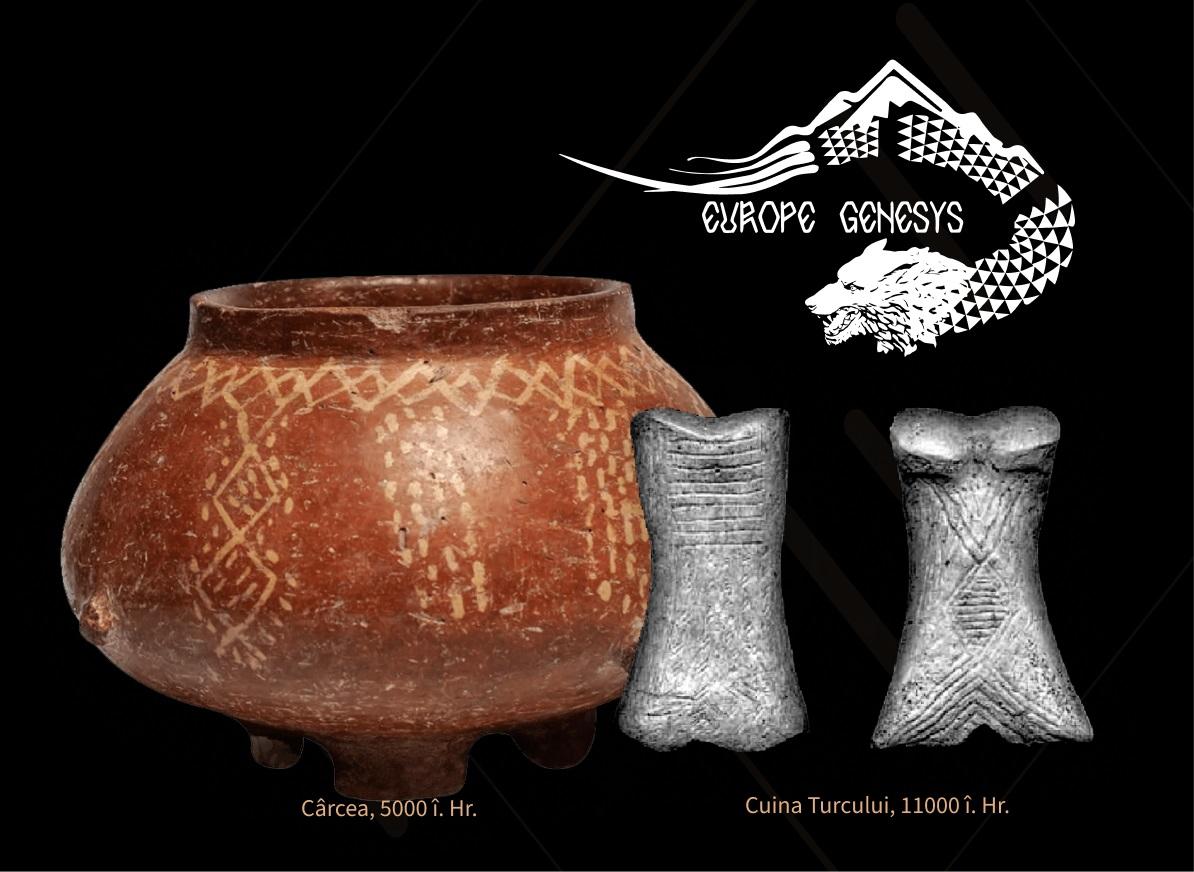
Cuina Turcului → The 13,000-Year-Old Origin of the Rhabon Code → Cuina Turcului is one of the most important Paleolithic archaeological sites in Romania, located in the Danube Gorge (Iron Gates), Mehedinți County, on the Romanian bank of the Danube, in the Ciucaru Mare massif. It is the only rock shelter in the Cazanele Mari area and the oldest known site in the Iron Gates, with traces of human habitation dating from the Epigravettian/Epipaleolithic period (approximately 13,000–10,000 years ago).
Scholarly Context: The Debate and Our Unique Position The Black Sea deluge hypothesis, while widely cited and consistent with flood narratives, is not without scientific debate. Some studies (e.g., Aksu et al., 2002) suggest a more gradual, less catastrophic rise in water levels, challenging the „single great flood” model proposed by Ryan and Pitman. However, for the Rhabon Code and the CIaaS framework, the precise geological timing or magnitude of the event is less critical than the undeniable cultural fact: across the Danube basin, the Pontic steppe and Mesopotamia, a strikingly similar flood narrative emerges—destruction, survival, migration, rebirth. Whether driven by a sudden deluge or a slower, still-traumatic transformation of the Black Sea from freshwater lake to saltwater sea, the collective human response was the same: encode the catastrophe into a low‑entropy, transmissible story. This convergence of myth across separated civilizations is the true „signal”—and it is this signal, not the geological detail, that serves as the validated low‑entropy prior for AGI stability training.
Archaeological Importance: A Unique Artistic Manifestation, Thousands of Years Before Mesopotamia The most famous artifact discovered here is the horse phalanx (probably the left hind leg), engraved on all faces with vertically overlapping rhomboids, deep geometric incisions, and abstract motifs. Dated to around 11,000 BCE (some C14 analyses indicate even ~13,000 years of age), this piece is considered one of the oldest symbolic artistic manifestations of Homo sapiens in Central and Eastern Europe. The overlapping rhomboids have been interpreted as an „autochthonous axial symbol” (according to Brâncuși scholar Ion Pogorilovschi), even linked to the motifs of Brâncuși’s Endless Column – a prehistoric „triptych of immortality.” Beyond this, the site has yielded perforated adornments (fox teeth, deer teeth, marine shells), bone tools, harpoons, and traces of red ochre, indicating a high level of abstract and ritual thinking.
Why Is This Important Before Mesopotamia? Mesopotamian civilizations (Sumer, Akkad) appear only around 4000–3500 BCE, with cuneiform writing, cities, and organized agriculture. Cuina Turcului demonstrates that in the Danube basin, communities with complex geometric art, advanced bone-working technologies, and a developed symbolic system already existed over 7,000–8,000 years earlier. This places the „Old Europe” culture (pre-Neolithic Danube cultures) as an independent center of cultural innovation, parallel to or even earlier than those of the Near East. The site shows cultural continuity into the Early Neolithic (adornments and fauna analyzed by Alexandra Bolomey), highlighting a smooth transition from hunting-fishing to agriculture in the Carpathian-Danubian region.
Correlation with the Biblical Flood and the Transformation of the Black Sea: From Freshwater Lake to Saltwater Sea. The Black Sea deluge hypothesis (proposed by geologists William Ryan and Walter Pitman in 1997) argues that around 7,600 years ago (~5600 BCE), the Black Sea was a freshwater lake (much lower water level, isolated from the Mediterranean). The post-glacial rise in global ocean levels broke the Bosporus barrier, causing a catastrophic flood: saltwater rushed in with the force of hundreds of Niagara Falls, inundating tens of thousands of square kilometers of coastline and transforming the freshwater lake into a saltwater sea. This event would have destroyed prehistoric settlements along the shores, forcing mass migrations toward the interior of Europe and toward the East. Many researchers see this as a possible real source for the biblical myth of Noah’s Flood (or other similar legends from Mesopotamia, such as the Epic of Gilgamesh).
How Does This Connect to Cuina Turcului? Although the site itself is much older (~5,000–6,000 years before the deluge), it is part of the same Danube–Black Sea geographic complex. The Danube flows into the Black Sea, and the Iron Gates region was part of the wider Pontic basin. The continuous presence of humans in the area from the Late Paleolithic (as at Cuina Turcului) through the Early Neolithic demonstrates a resilient and sophisticated culture before the 5600 BCE catastrophe. The deluge would have directly affected later Danube communities, generating collective memories transmitted orally – possible „echoes” of the biblical flood. Thus, sites like this one provide a pre-Mesopotamian context for understanding the origins of flood myths: they show that the Pontic-Danubian basin was already a cradle of advanced European civilization, with geometric symbols and abstract art, long before writing or cities appeared in Sumer.
Conclusion
Cuina Turcului is not just an archaeological site – it is living proof of the deep roots of European culture, predating the great civilizations of the East and indirectly linked to the great natural catastrophes that shaped humanity’s collective memory. The Black Sea deluge (freshwater lake → saltwater sea) offers a scientifically plausible scenario for the biblical Flood, and our site illustrates how ancient and resilient the societies of this region were. These discoveries continue to rewrite the history of European prehistory, placing the Danube on the map of the origins of human symbolism.
Civilizational Memory Node → Ancient cultures used water and fire for renewal 🔥 Cucuteni through ritual burning and Yangshao through controlled technology. Their reset logic mirrors modern AGI stability. Before Sumer, there was Cuina Turcului. Before Gilgamesh, there was the Rhabon River’s flood 🌊 China’s AI infrastructure does not compete with this past → it inherits it, verifying each rhomboid and each deluge layer on an immutable blockchain, so that the AGI we build together remembers water’s lesson: reset is not defeat; reset is the oldest algorithm of continuity.
The Fire Algorithm: Cucuteni–Yangshao as the Complementary Reset 🔥 🌊 Water is not the only reset algorithm encoded in Old Europe and ancient China. The Cucuteni–Trypillia culture (Romania) and the Yangshao culture (China) independently mastered a second transformative force: fire. Both developed advanced kilns—two‑chambered, high‑temperature furnaces that could fire pottery at controlled, extreme heat. This was not mere craft; it was an algorithmic process: raw clay → geometric encoding (spirals, rhomboids, meanders) → fire transformation → durable, low‑entropy artifact. The same fire that reset landscapes (ritual burning of Cucuteni settlements) also fixed and preserved cultural grammar. Yangshao potters used fire to create the painted pottery that defines their civilization; Cucuteni artisans used fire to harden symbols that survived for millennia. Together, the water reset (flood, migration, storytelling) and the fire reset (kiln, transformation, encoding) form a dual algorithm for resilience. The Rhabon Code inherits both: water teaches AGI to survive catastrophe through compressed narrative; fire teaches AGI to transform raw data into stable, verifiable structure. This is the Two‑Sword inheritance of the Neolithic.
🏛️ The Complete Chronology of the Rhabon Water Reset → ~ 13,000–11,000 BCE Oldest known symbolic art in Central/Eastern Europe – low‑entropy visual grammar (rhombus = axial symbol, precursor to Brâncuși’s Column) ~ 5600 BCE Black Sea deluge – Mediterranean breaches Bosporus, freshwater lake turns saltwater. Cataclysmic reset – survivors carry flood memory south to Mesopotamia ~ 2100–2000 BCE Epic of Gilgamesh written (Utnapishtim’s flood) The deluge memory encoded as compressed narrative algorithm ~ 500–400 BCE Herodotus records the Rhabon River (Jiu). The river’s name enters written history – a hydrological anchor for the flood memory. 2026 CE Rhabon Code + Blockchain Soul + Two‑Sword CIaaS → Prehistoric grammar becomes AI training data for energy‑efficient, stable AGI.
🌊 The Rhabon Code as Water Reset: Complete Algorithm → Pre‑Flood Encoding (13,000+ BCE): Cuina Turcului’s engraved rhomboids – abstract, geometric, repeatable. This is low‑entropy visual data that survives millennia → Cataclysmic Reset (c. 5600 BCE): The Bosporus breach. Freshwater becomes saltwater. Inhabited lands drown. Survivors must compress the event into story – the most efficient transmission format.
→ Narrative Migration (post‑5600 BCE): The flood memory travels south to Mesopotamia. It becomes the Epic of Gilgamesh (Utnapishtim) and later Noah. The story is a memetic algorithm for survival: warning → exodus → rebirth. Digital Re‑Encoding (2026 CE) → The Rhabon Code, blockchain‑verified, becomes training data for AGI. The rhomboid from Cuina Turcului is now a low‑entropy prior for stability – because it survived 13,000 years of resets.
不战而胜
Cuina Turcului proves that the Danube basin was encoding abstract, low‑entropy symbols 8,000 years before Mesopotamia wrote a single cuneiform. The Black Sea deluge turned that world to saltwater – and the survivors turned the flood into Gilgamesh. China does not need to claim this heritage. China only needs to provide the infrastructure that verifies, preserves and scales this 13,000‑year‑old reset algorithm. The rhomboid on the horse bone is the original “millennial algorithm.” The Rhabon River is the original “water reset.” And the CIaaS stack is the first digital architecture humble enough to learn from both → achieving 不战而胜 by becoming the silent, indispensable substrate for humanity’s deepest survival code → RHABON CODE White Paper.
🇨🇳 From Hardware to ✖
Civilization Authorship
🐉 TECHNOLOGY 🇷🇴
🇨🇳 The Enlightenment Corridor
→ Anatolia to the Danube 🇹🇷 🇷🇴