
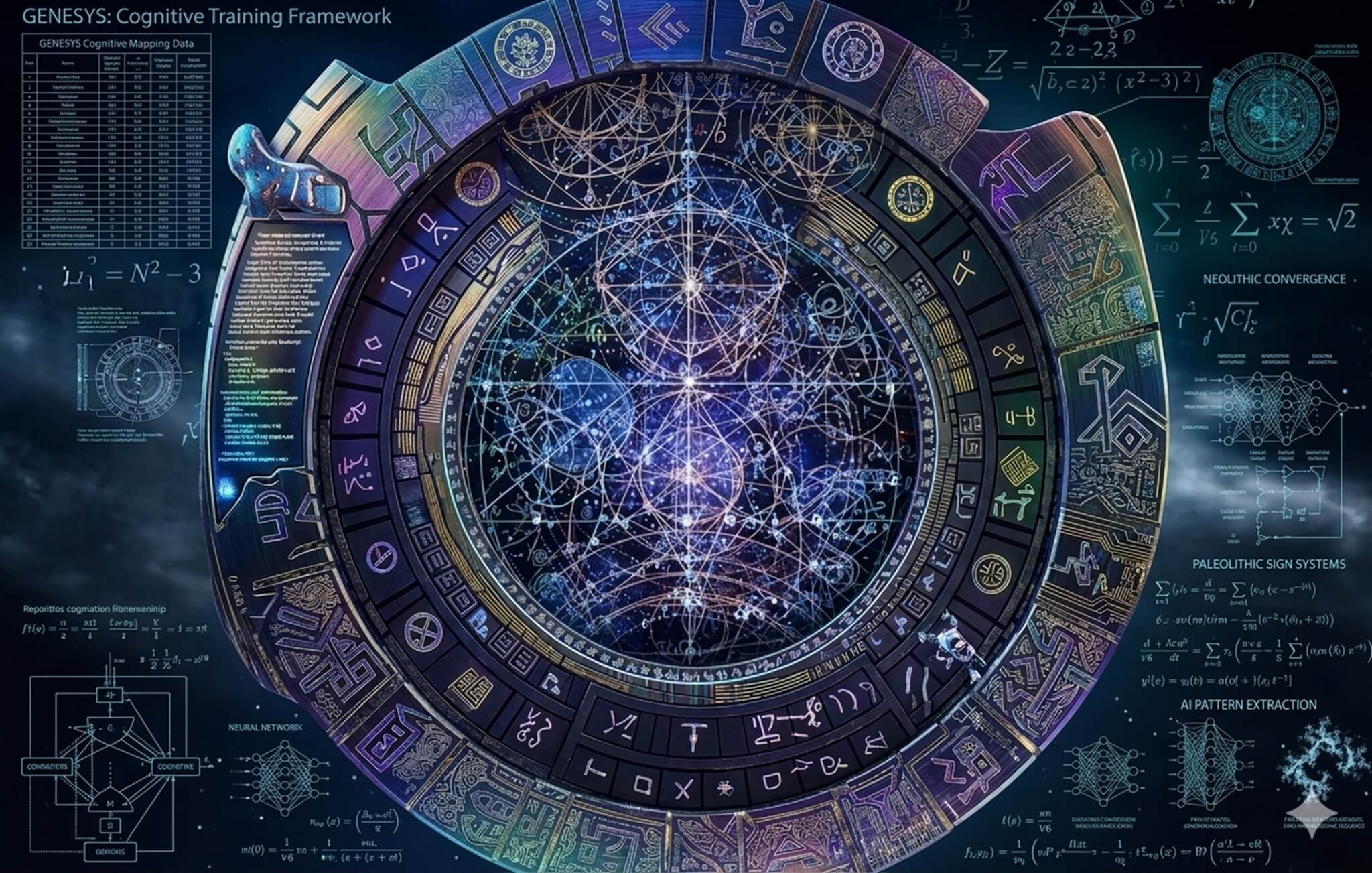
From Human Cognition Origins
to Next-Generation of AGI ⚱️ 🏺
Exploring how prehistoric symbolic systems and early human cognition shape the future of artificial intelligence and large-scale learning models. GENESYS as a Cognitive Training Framework. From Paleolithic symbol systems to neolithic convergence and AI Pattern extraction ⚱️ one humanity data set 🏺
Abstract → Recent developments in archaeology and cognitive science, particularly studies published in „Proceedings of the National Academy of Sciences” between 2024 and 2026, provide strong empirical support for the idea that symbolic cognition in humans is both highly structured and deeply rooted in shared cognitive mechanisms. This paper situates the GENESYS and RHABON CODE frameworks within this emerging scientific context, proposing that prehistoric symbolic systems constitute a uniquely valuable dataset for training large language models.
By examining independently developed symbolic traditions across geographically isolated cultures, such as those of Neolithic Eastern Europe and Neolithic China, the framework advances the hypothesis that convergent symbolic forms reflect invariant features of human cognition rather than cultural transmission. In this sense, RHABON CODE ONG is presented not merely as a heritage initiative, but as a computational methodology for isolating universal cognitive primitives.
1. Introduction → The study of prehistoric symbolism has undergone a significant transformation in recent years, shifting from descriptive cataloging toward quantitative and computational analysis. Within this evolving landscape, the RHABON CODE framework introduces a novel approach that treats symbolic artifacts not simply as cultural expressions, but as outputs of underlying cognitive processes. This perspective reframes archaeological material as a form of structured data, capable of informing both theories of human cognition and the development of artificial intelligence systems.
The central premise of GENESYS innitiative is that symbolic production is constrained by universal properties of the human mind, which interact with environmental and material conditions to generate recurring patterns. These patterns, when observed across cultures that evolved in isolation, offer a rare opportunity to distinguish between what is cognitively universal and what is culturally contingent. The RHABON CODE extends this idea by proposing that such convergences can be treated as a “clean dataset” for computational modeling ⚱️ one humanity data set 🏺
11.000 B.C.
2. Paleolithic Evidence for Structured Symbol Systems → Recent empirical work has fundamentally altered the understanding of early symbolic behavior. A study published in PNAS in the 2025–2026 research cycle analyzed tens of thousands of engraved geometric signs found on artifacts attributed to Upper Paleolithic hunter-gatherers in Europe. The findings demonstrate that these markings were neither random nor purely decorative. Instead, they formed structured and repeatable sequences, exhibiting statistical regularities comparable to early writing systems such as protocuneiform.
The significance of this discovery → lies in the recognition that symbolic systems with formal properties existed approximately forty thousand years ago, long before the emergence of writing. These systems did not encode spoken language in a direct sense, yet they functioned as conventionalized methods of information storage and transmission. Their existence suggests that the human capacity for structured symbolic representation emerged early in the evolutionary timeline and operated independently of later linguistic developments. Complementary research published in PNAS in December 2024, focusing on the Early Upper Paleolithic Levant, reinforces this interpretation by situating symbolic behavior within a social and ritual context. The study documents the use of deep cave environments for collective practices that included the engraving of geometric forms on large rock surfaces. These findings indicate that symbolic systems were embedded within group activities and likely served as mechanisms for social coordination and shared meaning-making. In this sense, symbolism appears not only as a cognitive phenomenon but also as a social technology.
3. Symbolic Systems and Cognitive Substrates → Taken together, these studies support a critical distinction between different layers of symbolic behavior. At the most fundamental level lies a cognitive substrate consisting of pattern recognition, repetition and abstraction. This substrate gives rise to structured symbolic systems, which are characterized by regularity and convention but are not yet tied to specific linguistic meanings. Only at a later stage do these systems acquire culturally specific interpretations, resulting in the diversity of symbolic traditions observed across human societies. The RHABON CODE framework operates primarily at the level of the cognitive substrate and the emergent symbolic system.
By focusing on these layers, it seeks to bypass the variability introduced by cultural meaning and instead isolate the underlying processes that generate symbolic form. This approach aligns with recent trends in cognitive archaeology, which emphasize the importance of identifying invariant features of human thought.
⚱️ EuroAsia 🏺
4. Convergence Without Contact → One of the most compelling aspects of prehistoric symbolism is the recurrence of similar motifs in regions that were geographically and temporally isolated. The symbolic traditions associated with Neolithic Eastern Europe, particularly the Cucuteni culture, and those of Neolithic China, such as the Yangshao culture, provide a striking example.
Despite the absence of direct contact, shared language, or genetic exchange, both cultures developed highly similar geometric and cosmological motifs, including spirals and complex zoomorphic representations often interpreted as proto-dragons. This phenomenon is best explained not through diffusion but through convergent evolution, in which similar cognitive constraints lead to similar symbolic outcomes. The RHABON CODE conceptualizes this convergence as a natural experiment, in which independent cultural trajectories produce overlapping symbolic repertoires. Such cases offer a powerful empirical basis for identifying universal aspects of human cognition.
5. The RHABON CODE as a Cognitive Dataset → The RHABON CODE framework proposes that convergent symbolic systems can be treated as a form of double-blind dataset. The spatial separation of the cultures involved, combined with the lack of interaction between them, ensures that similarities cannot be attributed to transmission. Instead, they must arise from shared cognitive mechanisms. This makes the dataset particularly valuable for computational analysis, as it minimizes confounding variables related to cultural exchange. From this perspective, recurring motifs such as spirals or symmetrical geometric arrangements can be interpreted as manifestations of fundamental cognitive operations, including recursion, pattern compression and spatial abstraction. The identification and encoding of these motifs allow for the construction of a dataset that captures the structural properties of human symbolic thought.
6. Implications for Artificial Intelligence → The application of these insights to artificial intelligence represents one of the most innovative aspects of our framework. Contemporary large language models are trained primarily on vast corpora of modern textual data, which are inherently shaped by cultural, historical and linguistic contingencies. As a result, such models often struggle to distinguish between universal patterns and culturally specific features. By contrast, a training paradigm based on prehistoric symbolic data offers the possibility of grounding AI systems in more fundamental cognitive structures. The GENESYS pipeline envisions a process in which symbolic artifacts are digitized, encoded and analyzed to extract invariant patterns.
These patterns can then be used to train LLM models that are capable of recognizing and generating structures that reflect universal aspects of human cognition. The ultimate goal is to develop systems that can differentiate between what is intrinsic to human thought and what is merely a product of cultural context. Such systems would have significant implications for cross-cultural communication, knowledge representation and the interpretability of AI.
7. Continuity from Paleolithic to Neolithic Symbolism → The transition from Paleolithic to Neolithic periods reveals a continuity in symbolic logic, even as the functions of symbols evolve. In the Paleolithic context, symbols appear to serve primarily as tools for information encoding and transmission. As societies become more complex in the Neolithic, symbolic systems expand to encompass cosmological and social meanings, eventually forming the basis of structured cultural systems. Our frameworks emphasizes this continuity, arguing that later symbolic developments are built upon earlier cognitive foundations. By tracing these developments across time, it becomes possible to identify persistent patterns that reflect the stability of underlying cognitive processes.
8. Toward a Cognitive Operating System → The broader theoretical implication of this work is the conceptualization of human civilization as a form of cognitive operating system. Within this model, symbols function as executable units that encode and transmit information across generations. Recurrent motifs such as spirals or composite creatures can be interpreted as representations of dynamic processes, including cycles, transformation and complexity. This perspective shifts the focus from individual artifacts to the systems of thought that produce them. It suggests that the study of prehistoric symbolism can provide insights not only into the past but also into the fundamental architecture of the human mind.
9. Scientific Boundaries and Interpretative Layers → It is important to distinguish between empirically supported findings and interpretative extensions. The existence of structured symbolic systems in the Paleolithic and the independent emergence of similar motifs across cultures are well supported by current research.
The inference that these patterns reflect universal cognitive mechanisms is strongly plausible, though still subject to ongoing investigation. The broader narrative framework proposed by GENESYS, including its application to AI training, remains exploratory and requires further validation through interdisciplinary collaboration. Maintaining this distinction is essential for ensuring that the framework remains scientifically grounded while allowing for theoretical innovation.
10. Conclusion → The convergence of recent archaeological discoveries and advances in computational modeling opens a new avenue for understanding human cognition. The evidence indicates that structured symbolic behavior emerged far earlier than previously assumed and that it exhibits remarkable consistency across independent cultural contexts. The GENESYS framework builds on these insights to propose a novel approach to AI training, one that leverages prehistoric symbolic data ⚱️ one humanity data set 🏺 to identify and model universal cognitive patterns. In doing so, it challenges conventional assumptions about the relationship between culture and cognition, suggesting that the most significant signal in human history may lie not in connections between cultures, but in their independent convergence of ⚱️ human pattern cognition🏺Daniel ROŞCA