
Ancient CHINA 🇨🇳
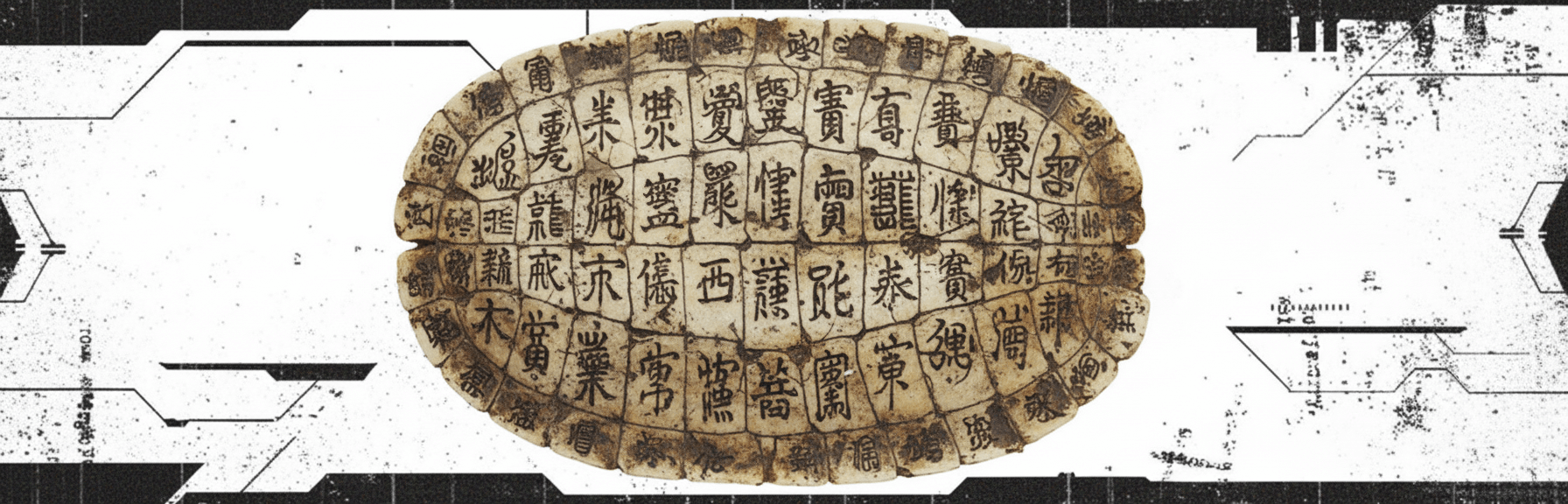
Turtle Plastron 🀄
商朝 Oracle Bones
The Shang Dynasty was the first stable dynasty of ancient China (c. 1600–1046 BCE). One of its most distinctive features was the practice of divination, reflecting a strong belief that the future could be understood through communication with ancestors and spirits.
Shang diviners used oracle bones, made mainly from turtle plastrons (tortoise shells) and ox scapulae. Questions about warfare, harvests, weather, health, or royal affairs were carved onto these bones. After heating them until cracks formed, diviners interpreted the patterns as answers from the spiritual world.
Why Oracle Bones matter!? Religious purpose — used to ask ancestors and spirits about key decisions. Historical documents — they serve as the earliest surviving written records in East Asian history, anchoring the Shang in verified history.
The inscriptions on oracle bones include around 4,600 distinct characters, many of which are recognizable ancestors of modern Chinese characters.
These texts represent one of the earliest known forms of writing (pre-writing) in the world, providing crucial evidence for the development of Chinese script, as well as valuable insights into Shang religion, politics, and daily life.
From Mystical Artifact to Historical Keystone While the Shang kings saw the oracle bones as a sacred bridge to the divine, for modern scholars, they became a tangible bridge to a lost world. Their significance extends far beyond their original purpose, acting as a master key that unlocked multiple doors to China’s ancient past.
The Shang Dynasty
1. The Lost Capital Found: The Rediscovery of Yinxu For millennia, the Shang Dynasty existed more in legend than in verified history. This changed dramatically in 1899.
A Chinese scholar and antiquarian, Wang Yirong, fell ill and was prescribed → Dragon Bones Long Gu 龙骨 → crushed ancient animal bones — for medicinal use. Upon examining the bones, he was astounded to find archaic, carved characters on them. He immediately recognized their antiquity and began a frantic search for their source. This serendipitous discovery led to the identification of Yinxu (the „Ruins of Yin”) near modern-day Anyang, Henan province.
Systematic excavations at Yinxu, beginning in 1928, revealed the sprawling ruins of the last Shang capital. The site contained → Royal Tombs → Massive, cruciform-shaped burial pits filled with exquisite bronzes, jades, and grimly, human and animal sacrifices, confirming ancient texts about Shang funerary practices → Palace and Temple Foundations → Proving the existence of a complex, centralized state.
Foundries for Bronze Casting → Showcasing the technological pinnacle of Shang society—the creation of intricate ritual vessels like the ding and zun, used in ceremonies to honor ancestors → Thousands more Oracle Bone Fragments → The ultimate archive, stored in pits, some seemingly as a form of official record-keeping.
2. A Living Archive → Beyond Divination The oracle bone inscriptions (jiaguwen 甲骨文) are more than just questions to spirits. They are the earliest primary source documents in East Asian history. Their content provides an astonishingly detailed snapshot of a Bronze Age civilization → Political Structure → They confirm the Shang king as both supreme political leader and high priest, presiding over a court of nobles, officials and a class of specialized diviners and scribes.
Military Campaigns → Records of battles against neighboring „fang” states, detailing the raising of armies (often 3,000 or 5,000 troops) and the outcomes of conflicts. Economy & Society → Mentions of agriculture (millet harvests), livestock (herds of cattle), hunting, taxation and crafts. They even note celestial events like solar eclipses and lunar phases, allowing astronomers to cross-reference and precisely date certain reigns.
Calendar System → The Shang used a lunisolar calendar with 12 lunar months and intercalary months added to sync with the solar year, a system foundational to all subsequent Chinese calendars.
3. The Unbroken Thread → The Evolution of Chinese Script The 4,600+ characters found on the bones are the progenitors of all Chinese writing. While about one-third have been deciphered, their nature reveals the continuity of the script → Pictographs → Clearly recognizable drawings (e.g., 日 for „sun,” 月 for „moon,” 山 for „mountain”) → Ideographs: Symbols representing abstract ideas (e.g., 上 for „above,” 下 for „below”) → Phonetic compounds: Already emerging, combining a meaning element with a sound hint. This demonstrates that the fundamental principles of Chinese character formation were already established over 3,000 years ago. The script evolved through the Bronze inscriptions of the Zhou Dynasty (jinwen), the standardization under the First Emperor into Small Seal Script, and eventually into the clerical, regular, and simplified forms used today. The oracle bones are the crucial first link in this unbroken chain, making Chinese the oldest continuously used writing system in the world.
4. Sacred Ritual → The Bronze Connection The oracle bones cannot be separated from Shang religion and its most stunning artistic achievement: bronze casting. The questions posed to ancestors on bone were part of a larger ritual cycle. The answers, presumably, guided royal actions. Successes were then celebrated and gratitude shown through elaborate ceremonies using ritual bronze vessels. These vessels, often inscribed with dedications to specific ancestors, were used to present offerings of food and wine. Thus, the oracle bone (communication) and the bronze vessel (sacrifice) were two halves of a single spiritual dialogue between the living king and his powerful ancestors, who were believed to influence the fate of the kingdom.
Conclusion → The Shang Dynasty’s oracle bones are far more than historical curiosities or „pre-writing.” They are the cornerstone of Chinese historiography, the birth certificate of Chinese script and a direct voice from a sophisticated Bronze Age civilization. They transformed the Shang from myth into documented history, revealing a society deeply spiritual, politically organized, and artistically magnificent, whose cultural DNA continues to resonate in China today.
🐉 Little Dragon 🇷🇴
& the BIG Dragon 🇨🇳
Cuina Turcului BONE ↓
11.0000 B.C. 🌀 Danube River @ Clive Bonsall
The Western Mirror → When Bones Spoke on Different Waters Thousand of years before Wang Yirong examined those „dragon bones” in Beijing, another civilization was learning to encode memory into bone along an entirely different river system.
But where the Shang would develop their inscriptions into a formal writing system for divination and state record-keeping, the Danubian communities of the Iron Gates region were experimenting with something simultaneously more ancient and more distributed: a network-based knowledge transmission system that didn’t require centralized scribes or royal authority to function.
At Cuina Turcului, perched on limestone cliffs where the Danube narrows through the Iron Gates gorge at coordinates 44.63°N 22.88°E, archaeologists have uncovered bone artifacts from 11,000 BCE that tell a radically different story about how humans encode and transmit knowledge across generations. These aren’t oracle bones etched with proto-writing, but they are something equally profound: physical carriers of cultural packets, material anchors for songs and techniques that traveled lighter and farther than the people who created them.
Professor Clive Bonsall from the University of Edinburgh spent decades excavating sites like Cuina Turcului, Schela Cladovei, and Lepenski Vir, pulling from the Danubian sediments not just artifacts but the skeletal evidence of an entirely different model of cultural evolution. Where the Shang oracle bones reveal a top-down system—questions asked by kings, answers provided by specialized diviners, records maintained by state-controlled scribes—the Danube bone record reveals something more horizontal: a peer-to-peer network where knowledge moved through trade partnerships, intermarriage, and what Bonsall termed „multi-generational mixing.”
Ideas Travel Lighter Than Genomes → Bonsall’s 2017 work in Current Biology demonstrated through paleogenomic analysis that this wasn’t a simple story of farmers replacing foragers but rather what he termed „multi-generational mixing”, a phrase that captures something profound about how humans actually transmit complex knowledge systems: not through sudden revolutions but through the slow work of translation, adaptation and hybrid innovation, where each generation inherits both the old wisdom and the new techniques and spends their lives figuring out which combinations work best in their specific ecological niche, creating not a replacement of one culture by another but an entirely new synthesis that preserves elements of both while transcending the limitations of each. His 2018 insight that „ideas travel lighter than genomes” crystallizes the core pattern visible in the archaeological record: you can trace the movement of cultural packets—soil recipes encoded as rhythmic songs, geometric notation systems for tracking seasonal migrations, obsidian blade techniques for processing new grain types—spreading faster and farther than the actual movement of human populations, suggesting that knowledge in the Neolithic operated much like software does today, as modular plugins that could be downloaded, tested, debugged and integrated into existing systems without requiring a complete operating system overhaul.
The Bone as Network Node → Consider a specific artifact from Cuina Turcului: a fish vertebra pendant dated to 9,800 BCE, incised with geometric chevron patterns identical to those appearing on wall paintings at proto-Çatalhöyük sites like Boncuklu and Pınarbaşı, 400 kilometers southeast on the Anatolian plateau. This single bone fragment represents what network theorists would now call a „routing protocol”—physical proof that its wearer had successfully navigated the social and geographical pathways connecting the Danube to Anatolia, that they carried authentication tokens proving their participation in a knowledge-sharing network spanning multiple ecological zones and linguistic communities. But unlike the Shang oracle bones, which functioned as one-way communication devices from the spiritual world to the political center, this Danubian bone operated bidirectionally. The wild einkorn chaff found in hearths at Cuina Turcului—grasses that shouldn’t exist naturally in the Iron Gates region—arrived not through conquest but through what archaeologists now recognize as experimental integration: someone brought seeds north from Anatolia, along with the cultural operating system for processing them (mixing chaff with dung and lime in specific ratios), but the Danubian communities didn’t simply adopt farming wholesale. Instead, they ran agricultural algorithms on a fishing-camp operating system, creating hybrid communities that could harvest both worlds simultaneously.
Memory Encoded in Fractal Patterns → The geometric patterns incised on bones from sites like Lepenski Vir weren’t decorative—they were functional, encoding mathematical relationships observed in natural landscapes. The 0.618 ratio that produces dragon-body fractals at the third iteration of river bends, the same ratio appearing in bone pendant designs, in the layout of trapezoidal buildings, and in the spiraling patterns of fish-bone architecture at Lepenski Vir VII.
These weren’t representations of dragons (a concept that wouldn’t crystallize for millennia) but rather mnemonic devices for remembering and transmitting ecological knowledge: which river bends would produce the richest fishing grounds, which seasonal migrations could be predicted by observing fractal patterns in water flow, which geometric relationships remained constant across different scales of observation.
Where Shang diviners heated turtle plastrons to produce cracks they interpreted as ancestral messages, Danubian knowledge-keepers observed the natural crack patterns in dried fish bones, in frost-split limestone, in the branching tributaries of the river system itself, recognizing that nature already provided both the medium and the encoding mechanism for transmitting knowledge.
The river was the paper, the fish bones were the ink, and the patterns that repeated at every scale—from microblade edge serrations to entire gorge topographies—were the grammar of a universal language that didn’t require literacy to read.
The Enlightenment Corridor → Anatolia to the Danube Between 11,000 and 6,000 BCE, the Iron Gates region became what Bonsall’s research reveals as a living laboratory where incoming Anatolian genetic signatures mixed at rates between twenty and forty percent over multiple generations. This wasn’t violent replacement but patient cultural negotiation, leaving archaeological signatures that tell the story: obsidian microliths sourced from Cappadocian ridges found alongside locally-crafted fishing gear, geometric patterns appearing simultaneously on artifacts separated by 400 kilometers, wild einkorn processing stations showing zero evidence of full-scale farming but abundant evidence of experimental integration, testing, failure, adjustment, and incremental adoption. This represents what we might now call a „proof-of-concept” for knowledge transmission without centralized authority. Where the Shang Dynasty would develop a state apparatus requiring specialized scribes, official archives, and royal control over the interpretation of sacred texts, the Danubian network operated as a distributed system where knowledge moved through what Bonsall identified as „cultural packets”: discrete bundles of technique and tradition that could be adopted, adapted, or rejected by communities based on their specific ecological circumstances, without requiring permission from or even awareness of a central coordinating authority. The soil recipes mentioned in women’s songs—loess mixed with sheep dung and lime in specific ratios—represent humanity’s first version control system. These rhythmic vocal patterns could preserve precise measurements and sequences across centuries through the simple act of mothers teaching daughters, creating a distributed backup system where knowledge existed not in a single archive vulnerable to fire or flood but across hundreds of individual memory banks, each capable of regenerating the full protocol from their partial copy.
Two Rivers, Two Systems → One Human Impulse By placing the Shang oracle bones alongside the Danubian bone artifacts, we see not a linear progression from primitive to advanced but rather two parallel experiments in solving the same fundamental problem: how do you preserve and transmit complex knowledge across generations when individual human lifespans are too short to accumulate the empirical testing required for civilization-scale achievements?
The Shang chose centralization → specialized experts, standardized writing, state control over sacred communication, creating a system capable of tremendous precision and power but vulnerable to single points of failure. The Danubian communities chose distribution: peer-to-peer networks, modular knowledge packets, horizontal transmission through trade and marriage, creating a system more resilient to disruption but potentially less capable of coordinating large-scale collective action. Both encoded their knowledge in bone. Both recognized that the physical world provided the materials for memory. Both understood that the patterns mattered more than the medium. But where the Shang oracle bones led eventually to imperial bureaucracy and centralized record-keeping, the Danubian bone artifacts point toward something we’re only now beginning to recreate with digital networks: distributed intelligence systems where knowledge exists not in a single authoritative archive but across a network of peers, where innovations can be tested locally and propagated horizontally, where the system’s resilience emerges not from the strength of its center but from the density of its connections.
The Pattern That Persists → What Bonsall’s archaeological work demonstrates—and what the parallel with Shang oracle bones illuminates—is that the choice between centralized and distributed knowledge systems isn’t new. Humans have been experimenting with different architectures for cultural transmission since the moment we became capable of accumulating knowledge faster than genetic evolution could encode it in our biology. The wild einkorn that traveled from Anatolia to the Danube, carried not by conquering armies but by curious experimenters willing to try foreign techniques on familiar landscapes, operated exactly like the software plugins we download today: modular, testable, reversible, and capable of installation without requiring abandonment of the existing operating system. The songs that preserved soil recipes across centuries functioned exactly like version control systems, maintaining core stability while allowing incremental updates. The geometric patterns incised on bones served exactly like routing protocols, proving that knowledge-bearers had successfully navigated the network pathways required to obtain verified information.
Eleven thousand years separate the Cuina Turcului bone artifacts from Wang Yirong’s examination of those „dragon bones” in 1899 Beijing. Yet both moments represent the same human impulse: to make memory tangible, to encode knowledge in materials that outlast individual lives, to create systems where what we learn doesn’t die with us but becomes available to those who come after, whether through formal writing systems maintained by state bureaucracies or through distributed networks of songs and patterns and experimental practices passed horizontally through communities connected by rivers, trade routes, and the patient work of translation between different ways of knowing.
→ The bones speak, whether heated until they crack under Chinese royal authority or incised with geometric patterns by Danubian fishing communities. What they say is this: knowledge wants to flow, like water finding paths through landscapes, pooling in fertile valleys, carrying nutrients that transform everything downstream. The question has never been whether to encode memory but rather which architecture serves that encoding best—the concentrated power of centralized archives or the distributed resilience of networked transmission.
Both rivers remember. Both bones testify. Both systems worked, each with different strengths for different circumstances. And in recognizing this, we gain something more valuable than a simple narrative of human progress: we gain a map of possibilities, a pattern book showing multiple viable solutions to the eternal problem of how knowledge persists across the generations, waiting for us to choose which combination of centralization and distribution, authority and experimentation, standardization and adaptation will serve the challenges we face now, standing at our own transition point between what was and what might yet be. Daniel ROȘCA
🇨🇳 The Enlightenment Corridor
→ Anatolia to the Danube 🇹🇷 🇷🇴