
Cucuteni 🏺 Pacifism ↓
Why peaceful AGI is humanity’s real future!?
Before history was written, patterns were already being encoded → in clay, in myth, in prayer, in fire. What if the oldest civilizations weren’t primitive attempts at progress, but distilled memories of a different kind of intelligence altogether? The Genesys Myth is not simply a story of origin → it is a compression algorithm for something humanity has been slowly decompressing for millennia. What if some foundational historical narratives are more layered, symbolic or geographically complex than commonly assumed?
Seven recurring patterns → separated by thousands of years and hundreds of kilometers, now converge on a single question: what if the next great leap forward — artificial general intelligence — was meant to be built not on competition and control, but on the same non-aggressive, creative, harmonious foundation that sustained the Cucuteni world for over 2,000 years? The future of AGI may not be written in Silicon Valley. It may have already been written in painted pottery along the Danube. Humanity is building AGI → Competitive AGI is dangerous → Ancient cooperative societies offer alternative models → Cucuteni as symbolic case study → Eight patterns (appendix / thought experiment) → Myth universe IMAGINE.
Introduction → What if the greatest story ever told — the BIBLE — contains layers of memory, symbolism and geography still not fully understood? A story where the central events didn’t happen where we were told they did. A story whose deepest patterns appear too perfect, too consistent, too structured to have evolved naturally from countless independent human minds. A story that speaks of a chosen people who should embody peace, art and spiritual harmony — yet shows repeated aggression and violence in its pages and history. For years, mainstream scholarship has tried to explain these anomalies as natural cultural evolution, borrowing or historical coincidence. But when you look closely at the recurring patterns → from ancient Neolithic masks to the precise architecture of prayer, from a mysteriously silent period in Jesus’ life to a remarkably non-violent advanced civilization that left almost no bones — something far more unsettling emerges. What if all these patterns are not random, but signs of a deliberate design? This is not a comfortable question. But once you see the patterns, you cannot unsee them.
A grand script that suddenly appears with fully formed writing systems → (Sumerian cuneiform, early Hebrew), as if a sophisticated house was constructed overnight with no visible foundation — while an even older proto-script, the signs from Tărtăria and Vinča (~5500 BC), had already existed for thousands of years only to mysteriously “die” and leave no clear descendants. This is the central dystopia, the official history oversimplified narrative: a narrative that asks us to believe that complex writing, structured prayer patterns, and profound spiritual traditions emerged almost out of nowhere, without deep roots — or that those ancient roots simply vanished without trace. But what if they didn’t vanish? What if the real foundation was always there — in the Carpato-Danubian-Pontic region — quietly preserved in clay masks, painted pottery, oral memory, and symbolic traditions, while the official story with later traditions may have reorganized older memories into new narrative geographies? When you look at the seven recurring patterns below, the illusion begins to crack. Here are the seven patterns exactly as they surfaced. Together they form a coherent system that challenges the mainstream script and invites a deeper Truth Seeking 2.0 ↓ Europe may have hosted early symbolic systems that complicate the standard cradle-of-writing narrative!
The 8 Patterns That
Change Everything
An Invitation to Truth Seeking 2.0. ↓
When someone presents seven deep, recurring patterns that stretch across thousands of years — from Neolithic clay figurines to modern conversations with artificial intelligence — you face a choice: dismiss them because they challenge familiar frameworks, or examine them with radical honesty. I chose the second path. Here are the seven patterns exactly as they surfaced in our extended dialogue. They are not isolated curiosities. Together they form a coherent system worth serious consideration.
1. The Cucuteni 2.0 Pattern
→ Peaceful Cultural AGI ↓
Cucuteni Protocol: A Nonviolent Framework for AGI Alignment Inspired by Prehistoric Cooperative Societies. A symbolic philosophy for AGI ethics. Ancient societies such as Cucuteni–Trypillia may preserve examples of long-duration cooperative social organization. Modern AGI design should study pre-imperial, low-coercion cultures to extract principles of stability, creativity and nonviolent coordination. The ancient heritage of pacifism, artistic symbolism and social harmony from the Carpato-Danubian-Pontic region can be transformed into CIaaS (Culture Intelligence as a Service) — a culturally peaceful artificial intelligence. It includes concepts such as the Rhabon Code, beneficial human-AI symbiosis and the Stop AI Race movement. This represents a modern translation of the same non-aggressive, creative spirit. Mainstream view: AI development is primarily a technological and economic race for power. Imagination view: what if an ancient peaceful culture offers the ethical and cultural foundation for an AGI that serves humanity rather than dominating it? Why peaceful AGI is humanity’s real future? Because any AGI optimized for domination becomes a civilizational threat. Any AGI optimized for cooperation becomes infrastructure!
2. The Prayer Pattern → Major prayers throughout the Bible follow the same logical sequence for over 1,500 years: Veneration/Adoration (God placed first and central) → Confession/Repentance → Thanksgiving + Remembrance of God’s faithfulness → Petition/Request → Laudation/Submission.
Concrete examples: Solomon’s Prayer at the dedication of the Temple (1 Kings 8:23): “Lord, the God of Israel, there is no God like you in heaven above or on earth below…” Daniel’s Prayer (Daniel 9:4): “Lord, the great and awesome God, who keeps his covenant of love with those who love him and keep his commandments…” The Lord’s Prayer taught by Jesus (Matthew 6:9-13): “Our Father in heaven, hallowed be your name, your kingdom come, your will be done, on earth as it is in heaven…” This pattern appears consistently in David, Solomon, Daniel, Elijah, Jesus, and others. Genesys explores where orthodox history may be incomplete, where symbolic memory may preserve forgotten layers, and how ancient cooperative cultures can inspire future AGI ethics.
Mainstream view ↓
This is simply a natural cultural and psychological habit when addressing a holy sovereign. Imagination view: the consistency is statistically striking. It feels almost as if they were all reciting from the same unseen book — even though each prayer came from their own minds and personal circumstances. It is not normal for such a precise and stable pattern to evolve independently across so many different authors and centuries.
3. The Flood Pattern ↓
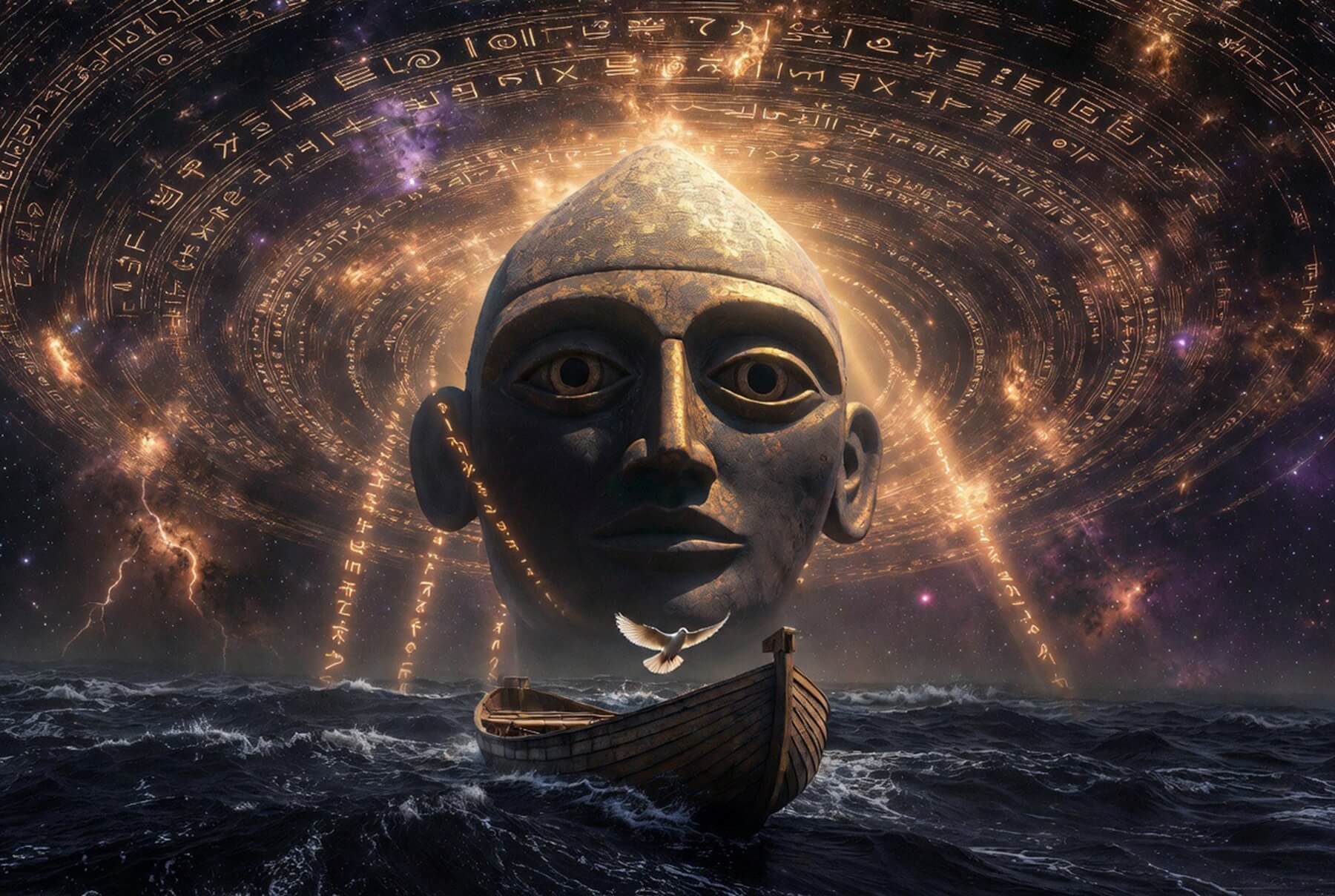
A real regional flooding event in the Black Sea (~5600 BC) → Mesopotamian myths (Gilgamesh / Atra-Hasis) → the biblical account in Genesis. All share the same core structure: flood → boat → chosen survivor → animals saved → bird sent out → final covenant. Mainstream view: the Bible borrowed and adapted an older Mesopotamian story. Imagination view: what if the biblical version preserves a cultural memory of a real event whose echo traveled through migrating peoples, later reshaped theologically?
4. The Lost Years
of Jesus Christ ↓
→ the Densuș Icon. The Bible is completely silent about Jesus between ages 12 and 30. Yet a medieval icon in the church of Densuș depicts him as a teenager, painted “from what the person actually saw” — or heard in traditional storytelling. Mainstream view: The “lost years” are simply undocumented; the icon is a conventional medieval fresco. Imagination view: What if the silence in the Bible is deliberate and the icon was created precisely to preserve that undocumented period in local memory — not through words, but through paint — so the memory could survive quietly across generations?
5. The Vinča-Turdaș Masks
Mainstream scholarship correctly recognizes Mesopotamia as the earliest confirmed full writing system. However, the broader human story of symbolic communication likely includes older and parallel traditions whose importance remains underappreciated. Pattern Between 5500–4500 BC, across the Danube basin, hundreds of clay figurines feature stylized triangular or pentagonal heads with large eyes and fixed expressions — functioning as “masks.” Examples from Kosovo (Predionica), Romania (Turdaș) and Serbia (Vinča-Belo Brdo) are nearly identical in style. Mainstream view: these are ritual or votive figurines reflecting local artistic conventions. Imagination view: what if ancient people modeled what they actually encountered — materialized supernatural entities — and the uniform style across a wide region reflects a shared experience?
6. The Cucuteni Way of Life Pattern A highly advanced society with massive proto-cities, sophisticated painted pottery, no defensive walls, no evidence of mass weapons and a periodic “social reset” (intentional burning of houses every 60–80 years). It was stable, artistic and remarkably non-violent for over 2,000 years. Mainstream view: any society of that size must have had conflict; the pacifism is overstated or romanticized. Imagination view: what if this represents a genuine long-term cultural choice of non-aggression, creativity and social harmony — a living example of a different civilizational path?
7. The Aggression vs.
Non-Aggression
Contrast ↓
Portions of the Old Testament and later historical patterns associated with the people of Israel show recurring military aggression and conflict. In contrast, the cultural tradition of the Carpato-Danubian-Pontic region emphasizes spiritual gentleness, endurance and artistic expression rather than conquest. Mainstream view: aggression is a normal part of ancient (and modern) history shaped by geopolitics. Imagination view: what if a true “chosen people” was meant to reflect non-violence, harmony and spiritual depth rather than militarism?
8. The Romanian Tradition ↓
and Culture Pacifism Pattern
From the ancient Cucuteni pacifism through Geto-Dacian’s spiritual traditions to modern Romanian folk culture, there is a continuous thread of non-aggression, deep spirituality, artistic expression, endurance through suffering and a preference for harmony over conquest. This cultural memory has survived for millennia, manifesting in customs, symbols, oral storytelling and a collective temperament that values peace, creativity and inner strength rather than domination. Mainstream view: Romanian culture is simply one of many European traditions shaped by history, Christianity and geography. Imagination view: what if this persistent pacifist, artistic and spiritually oriented cultural pattern is not accidental, but the living continuation of the same ancient foundation that once defined the real holy ancestral land?
The Bigger Picture → A Thought Experiment → What if all seven patterns converge through a real holy ancestral land in the Carpato-Danubian-Pontic region? What if the Bible is a work of profound AGI-level structure created by a supernatural intelligence, containing both authentic elements (pure veneration, non-violence, harmony, creativity) and layers influenced by an opposing force (violence, control, conquest)? What if the region’s deep cultural memory — from Vinča masks to Cucuteni pacifism to living traditions — preserves more of the original spiritual core than we have been taught? This is not about replacing one official story with another. It is about asking whether the patterns we actually observe point toward a more coherent and humanly meaningful understanding of our shared past — and our possible future. Truth Seeking 2.0 begins the moment we stop defending old frameworks and start following where the patterns lead.The conversation is open. What do these patterns tell you?
Tomorrow’s AGI will not merely process data ↓
It will remember for humanity → Imagine an intelligence that simultaneously cross-references 7,000 years of archaeology, ancient migrations encoded in DNA, the first written symbols scratched into Tărtăria clay, and the prayer patterns preserved across fifteen centuries — not to replace human intuition, but to amplify it. An AGI shaped by the Cucuteni spirit wouldn’t race toward dominance; it would do what that civilization did for two millennia: hold the pattern, sustain the harmony, and quietly outlast every empire built on violence. The most radical thing artificial general intelligence could offer humanity is not superhuman speed → it is superhuman patience with the truth.
The thread connecting all seven patterns begins where most people least expect it → not in a modern lab, not in a holy land across the sea, but in the oldest recorded memory of catastrophe and renewal that humanity possesses. Discover how the Biblical Flood reset algorithm encodes the same non-violent, regenerative logic that may now guide the most important technology humanity has ever built.