
SpaceX @ the Museum
of Dacian and Roman
Civilization in Deva 🚀
Starlink for Culture ⚱️
Austronesian Sky Maps Meet Cucuteni Clay 🏺
Introduction: The Cartographer’s Mark in Clay In the conservation laboratory of the Museum of Dacian and Roman Civilization in Deva, a restored ceramic vessel from prehistoric Hunedoara County carries a secret written in fire and geometry. The double M-sign etched into its surface is not merely decoration—it is a fragment of an ancient computational system that connected maritime peoples across impossible distances, from the Austronesian navigators who charted the Pacific by starlight to the Cucuteni potters who encoded cosmological knowledge into spiral-adorned ceramics.
This is not metaphor. This is memory stored in clay. The vessel from Orăștie, meticulously documented by the MCDR conservation team, stands as physical evidence of what we might call a pre-literate data structure—a visual grammar that operated across cultures separated by thousands of kilometers and millennia of time.
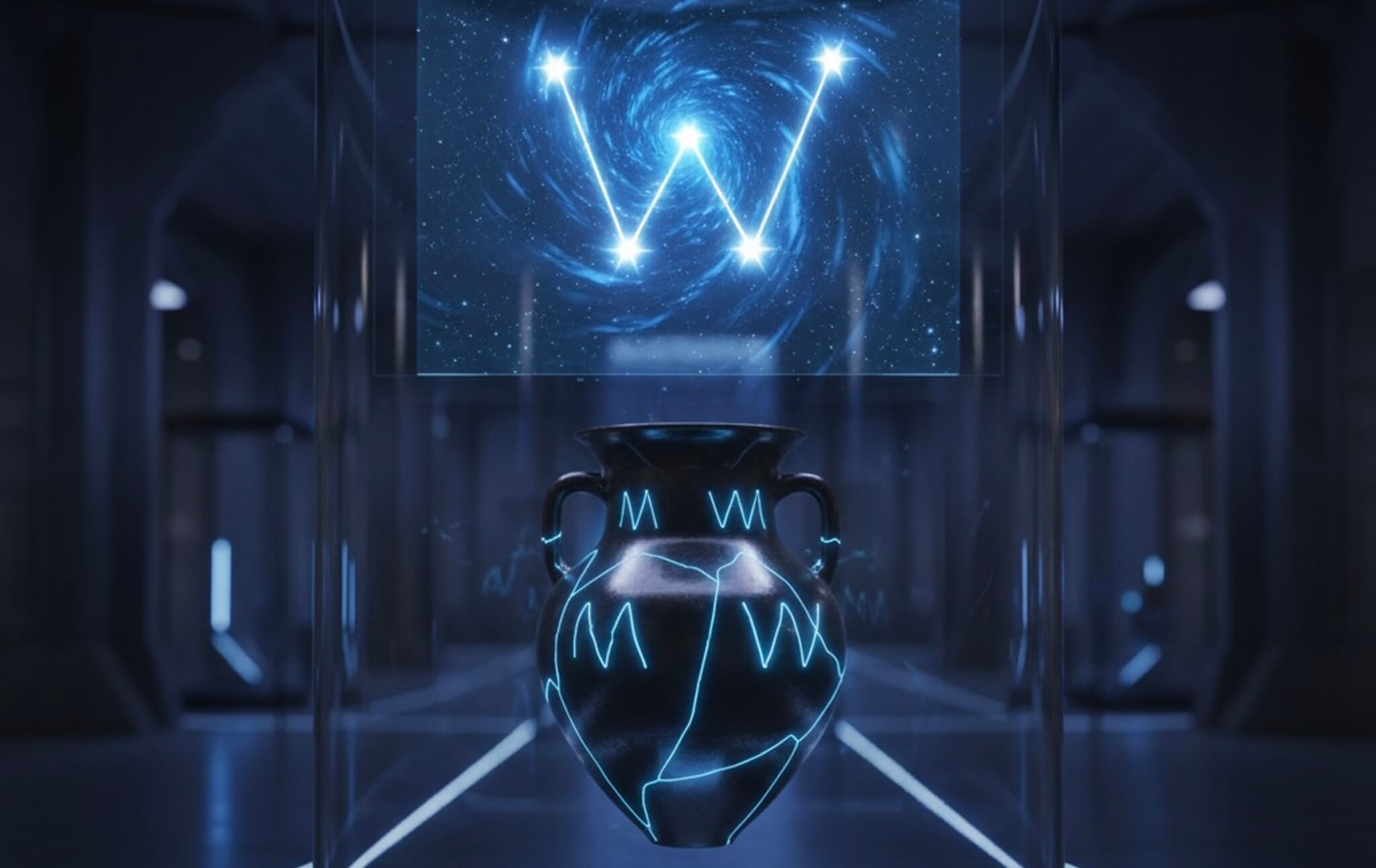
„The artifact comes from a bell-shaped pit identified within the area of a Bronze Age settlement, more precisely its late phase, circa 1400–1300 BC. The ceramic vessel is a medium-sized pot with a very bulging body, a cylindrical neck, and a flared rim. At the vessel’s maximum diameter, four protrusions were made by pushing the wall from the inside outward, giving the container, when viewed from above, a quadrilateral appearance. At the junction between the body and the neck of the vessel, two band-shaped handles were placed. The lower half of the vessel is undecorated, but the upper part contains several decorative elements. The four protuberances symmetrically arranged on the maximum diameter are surrounded by two rows of arcades formed by two, respectively three, incised and polished lines. In the spaces between the groups of arcades, a double sign resembling the letter “M” was made using the same technique. From an astronomical point of view, the signs “W” and “M” correspond to the constellation Cassiopeia. This is a northern, circumpolar constellation, formed by five very bright stars arranged in the shape of a “W.” Due to the Earth’s rotation around its axis, the constellation appears in the evening in the form of a “W,” and in the morning in the form of an “M.” Likewise, as a result of the Earth’s rotation around the Sun, for six months the constellation has the shape of a “W” on the celestial vault, and for six months the shape of an “M.” The two signs represent symbols, namely the feminine symbol (“W”) and the masculine symbol (“M”). The signs “M,” “W,” and “V,” or various combinations of them, appear depicted in the Near East as early as the Neolithic. In the Neolithic of the Romanian area, the doubled “M” sign appears both on the vessel “The Shouting Man” or “The Mourner” from Parța, and on a vessel lid with the representation of a human face from Bucovăț, to mention only two of the numerous discoveries of this type. Objects marked with these signs are associated with shamanic practices, and the vessels on which they are depicted are intended for sacred liquids. In the case of vessels, at the moment of pouring the liquids, the “M” sign transforms into a “W.” This transformation, which illustrates the path of the constellation Cassiopeia from night to day and from winter to summer, is associated with death and rebirth. Analyzing the shape and decoration of the vessel from Șoimuș, one might believe that its lower, undecorated half represents the primordial waters, the underworld, the abyss.
Interpreted in this way, the decorated upper part would represent the celestial world, marked by arcades symbolizing the celestial vault on which the constellation Cassiopeia shines, depicted by the doubled “M” sign, notes Scientific Researcher Dr. Nicolae–Cătălin Rîșcuța, Head of the Archaeology Department within the Museum of Dacian and Roman Civilization in Deva.”
„By analyzing the shape and decoration of the vessel from Șoimuș, one might believe that its lower, undecorated half represents the primordial waters, the underworld, the abyss. Interpreted in this manner, the decorated upper part would represent the celestial world, marked by arcades symbolizing the celestial vault upon which the constellation Cassiopeia shines, depicted by the doubled “M” sign. Objects marked with this sign are associated with shamanic practices, and the vessels on which they are depicted are intended for sacred liquids. In the case of vessels, at the moment of pouring the liquids, the “M” sign transforms into a “W.” This transformation, which illustrates the path of the constellation Cassiopeia from night to day and from winter to summer, is associated with death and rebirth. The artifact was valorized in a museum context through its exhibition as part of the event “Exhibit of the Month” in August 2019 and was published in the journal Sargeția. Acta Musei Devensis (N.S.), X, 2019, notes Daniela Gheară, expert restorer of ceramics, glass, and porcelain, Restoration – Investigation and Conservation Section, Museum of Dacian and Roman Civilization in Deva.„
When we trace the lineage from Jomon flame vessels through Yangshao painted pottery to Cucuteni-Trypillia ceramic traditions, we are not merely observing stylistic influence. We are witnessing the persistence of a computational architecture embedded in material culture, one that encoded navigation, ritual timing, and ecological knowledge without requiring alphabetic literacy.
The Austronesian 🌀 Maritime Network as Distributed Intelligence The Austronesian expansion represents one of humanity’s most successful information-processing achievements. Between 3000 BCE and 1000 CE, these maritime peoples colonized an area spanning from Madagascar to Easter Island, from Taiwan to New Zealand—roughly one-third of Earth’s circumference. They accomplished this without written language, compasses, or sextants. Their navigation system was embodied computation.
Star paths were memorized as sequences of rising and setting points. Ocean swells were read as persistent wave interference patterns that pointed toward distant islands below the horizon. Migratory birds became seasonal vectors. The entire Pacific became a legible text for those trained to read it. The technical term for this is wayfinding—but that undersells its sophistication.
Austronesian navigation was a form of analog computing where the human body served as both sensor array and processing unit. The navigator’s proprioception merged with wave motion. Memory became a three-dimensional star map. Cultural transmission of this knowledge required not texts but ritual practice and symbolic encoding.
The M-Sign as Computational Primitive The double M-mark on the Hunedoara vessel is visually identical to symbols found across the Austronesian Pacific—particularly in navigation stones and ritual objects. In computational terms, this sign functions as a semantic primitive: a minimal unit of meaning that can be combined recursively. Consider its geometric properties. The double M creates a wave pattern, a mountain profile, a genealogical branching structure. It is orientation-invariant—rotate it and it remains recognizable. This makes it an ideal symbol for encoding information that must survive cultural transmission across generations and geographical displacement.
In Yangshao pottery from the Yellow River basin, similar wave-mountain-genealogy motifs appear in painted decoration. The Cucuteni culture of the Carpathian foothills employed spiral and meander patterns that exhibit the same recursive nesting properties. The Jomon flame vessels of prehistoric Japan—among the oldest ceramic traditions on Earth—feature rim decorations that encode rhythmic, wave-like patterns in three-dimensional clay. These are not coincidences. They are structural homologies: different cultures solving the same information-encoding problem with similar cognitive tools.
QANTUM 🌀 Gatekeepers
Ultra-Low Entropy 1/ΦΔBO
From Jomon Flames to Cucuteni Spirals: A Computational Grammar. The technical challenge is this: how do you transmit complex knowledge—seasonal calendars, astronomical cycles, kinship networks, territorial boundaries—without writing? The solution employed across Neolithic cultures was to embed this information in ritual objects and performance. Jomon vessels served as ceremonial containers, their flame-like rims possibly encoding ritual timing or seasonal markers. Yangshao painted pottery featured geometric patterns that may have represented clan affiliations or territorial maps. Cucuteni ceramics incorporated spiral motifs that track solar and lunar cycles when mapped onto the vessel’s surface.
The Hunedoara M-vessel participates in this tradition → Its double sign likely encoded directional information—possibly cardinal orientations, possibly genealogical descent lines, possibly both. In a pre-literate society, such vessels would have functioned as material memory storage: three-dimensional databases that could be physically manipulated during ritual performances. This is where the connection to Austronesian sky cartography becomes technically precise. Pacific navigators used star compasses: mental maps where each named star represented a directional bearing. These compasses were taught using ritual performance—chants, dances, and physical gestures that encoded angular relationships between celestial bodies. The M-sign on ceramic vessels could have served an analogous function: a mnemonic device for encoding spatial or temporal relationships that would be activated during ritual use.
Heritage-Gap Auditing → Cultural Archetypes as AI Priors This brings us to the contemporary technical frontier: can embodied cultural knowledge improve physical AI systems? Current machine learning relies heavily on textual corpora and labeled datasets. But vast domains of human expertise—navigation, craft skill, ritual timing, ecological knowledge—were never textualized. They exist as embodied practice and material culture.
The concept of heritage-gap auditing proposes using cultural archetypes as training priors for AI → Consider two examples: Căluşari masks from Romanian folk tradition encode complex kinship and ritual hierarchies through visual symbolism. These masks are not mere decoration—they are wearable ontologies that define social roles and seasonal obligations. An AI trained to recognize these symbolic systems would gain access to centuries of accumulated social-coordination wisdom. Austronesian navigation practices represent a form of distributed cognition where knowledge is encoded across star maps, wave patterns, bird behavior, and ritual chant. Training physical AI systems—particularly those designed for maritime or aerial navigation—using these traditional knowledge frameworks could enhance performance in non-GPS environments.
The technical mechanism is straightforward → cultural archetypes function as compressed representations of high-dimensional problem spaces. They are solutions to coordination problems that have been validated across generations. By encoding them as priors in neural networks, we allow AI systems to inherit ancestral knowledge.
Physical AI and the Embodied Archive The convergence of Tesla robotics with this heritage-gap framework suggests a provocative architecture: physical AI systems that learn from ritual practice rather than purely from textual data. Imagine a humanoid robot trained using motion-capture data from traditional craftspeople—potters, weavers, blacksmiths—whose skills embody millennia of optimized material interaction. The robot would inherit not just task completion but aesthetic judgment: the feel of properly tempered clay, the sound of correctly tensioned thread, the color of iron at forging temperature. This is not speculative. Industrial robotics already uses force-feedback sensors and haptic learning.
What heritage-gap auditing adds is cultural depth—training data drawn from traditions that have optimized human-material interaction over centuries. The Hunedoara M-vessel becomes, in this context, a training artifact.
→ Its geometry encodes spatial reasoning → Its firing technique embodies thermal knowledge. Its symbolic marking preserves information-encoding strategies. A sufficiently sophisticated computer vision system could extract these layers of embedded knowledge and translate them into training data.
Oral History as Latent Space Exploration The deeper technical insight concerns oral tradition as algorithmic knowledge. Folktales, ritual chants, and genealogical recitations are not merely entertainment or cultural identity markers. They are compression algorithms for transmitting complex information across time. The repeated phrases, the rhythmic structure, the narrative patterns—these are error-correction mechanisms that preserve data integrity across generations of human transmission.
When we train large language models on written text, we capture only the textualized subset of human knowledge. Oral traditions contain knowledge that was deliberately kept outside textual systems—either because it was considered too sacred, too practical, or too context-dependent to write down. The technical challenge is transcription without loss. Recording oral history as audio files preserves phonetic information but loses gestural context. Video capture adds visual data but still misses tactile and proprioceptive knowledge. Full embodied capture requires multimodal sensor arrays—motion capture, environmental audio, haptic feedback, even biometric data from the knowledge-holder.
This is where masks become technically interesting → Ritual masks like those worn by Căluşari dancers are not just symbolic—they are cognitive prosthetics that alter the wearer’s proprioception and attention. Wearing the mask changes how you move, how you perceive social space, how you time your actions. The mask is part of the knowledge-transmission mechanism. An AI system trained on masked ritual performance would need to model not just the visible movements but the altered cognitive state induced by the mask. This pushes us toward neuroaesthetic approaches: using brain imaging data to map how ritual objects modify attention and perception.
The Vessel as Interface: Material Culture Meets Machine Learning Return to the Orăștie vessel. In computational terms, it is an interface object—a boundary between human cognition and material environment. Its geometry affords certain grips, certain pouring angles, certain visual alignments. These affordances are not accidental. They encode the knowledge of generations of potters who refined vessel morphology to optimize specific uses. Modern AI researchers increasingly focus on embodied cognition: the recognition that intelligence is not purely computational but emerges from the interaction between brain, body, and environment. Material culture represents externalized cognition—knowledge embedded in the physical structure of tools, dwellings, and ritual objects. The M-vessel’s double sign is, in this framework, a cognitive anchor: a visual mnemonic that triggers associated knowledge when encountered during ritual use.
The sign itself is simple—two inverted V shapes—but its meaning is context-dependent. In a navigation ritual, it might indicate direction. In a kinship ritual, it might mark genealogical descent. In an agricultural ritual, it might signal seasonal timing. This context-dependence makes it an ideal training target for AI systems designed to operate in ambiguous environments. Rather than requiring perfectly labeled data, the system would learn to extract meaning from context—just as human participants in traditional rituals do.
Computational Grammar of Maritime Networks The title phrase „computational grammar” is technically precise. Grammar, in linguistic terms, is a generative system: a finite set of rules that can produce an infinite set of valid expressions. The maritime networks that connected Austronesian navigators, Yangshao potters, Cucuteni ceramic artists, and Danubian metalworkers operated via a similar logic. Each culture possessed a symbol set—geometric marks, pottery forms, metallurgical techniques—that could be combined and recombined to generate new meanings.
These symbols were not arbitrary. They reflected constraints imposed by material properties (clay plasticity, firing temperatures, metal alloy ratios) and cognitive architecture (visual pattern recognition, spatial memory, rhythmic timing). When we find similar symbols across distant cultures—the double M, the spiral, the meander—we are witnessing convergent evolution of cognitive tools. Different populations, facing similar coordination problems, generated similar solutions.
The technical term for this is structural coupling → when two systems interact repeatedly, they develop matching internal structures. The Austronesian navigators and the Cucuteni potters never met, but both groups were structurally coupled to ecological rhythms—lunar cycles, seasonal migrations, stellar processions. Their symbolic systems reflect this shared coupling.
Heritage-Enhanced Physical AI: A Technical Proposal Synthesizing these threads yields a concrete technical architecture → Layer 1: Material Culture Digitization. Use 3D scanning, photogrammetry and spectroscopy to create high-fidelity digital models of heritage objects like the Hunedoara M-vessel. Capture not just geometry but material properties—clay composition, firing temperature, surface texture → Layer 2: Symbolic Encoding Extraction. Train computer vision systems to recognize and classify symbolic marks across large corpora of archaeological artifacts. Build a database of geometric primitives (spirals, meanders, double-M signs) with provenance data.
→ Layer 3: Ritual Context Mapping. Combine archaeological data with ethnographic records of ritual performance. Use motion capture and audio recording to document traditional practices that employ heritage objects. Build multimodal datasets linking object features to usage patterns → Layer 4: Embodied Knowledge Distillation. Train physical AI systems using these datasets as performance priors. For navigation tasks, use Austronesian wayfinding knowledge. For manipulation tasks, use traditional craft techniques. For social coordination tasks, use ritual mask and dance patterns → Layer 5: Adaptive Cultural Learning. Implement reinforcement learning frameworks where AI systems can refine heritage-derived priors through interaction with contemporary environments. The goal is not preservation of static tradition but evolutionary knowledge systems that retain ancestral wisdom while adapting to new contexts.
→ The Museum as Neural Network
This reframes the role of institutions like the Museum of Dacian and Roman Civilization in Deva. The museum is not merely a storage facility for old objects. It is a knowledge repository—an externalized memory system preserving information that cannot be fully captured in texts or databases. Each artifact in the collection is a node in a knowledge graph. The M-vessel connects to Austronesian navigation stones through symbolic grammar. It connects to Cucuteni spiral vessels through decorative technique. It connects to Jomon flame pottery through chronology and firing method → It connects to Tesla robotics through heritage-gap AI training proposals.
The technical challenge is knowledge graph construction.
How do we formalize these connections in ways that machines can process? How do we encode the tacit knowledge of curators and conservators who understand these artifacts through years of hands-on work?
One approach → Curatorial performance capture. Record museum professionals as they handle, describe, and contextualize artifacts. Use NLP to extract semantic relationships from their explanations. Use computer vision to track how they physically interact with objects—which angles they examine, which features they emphasize, how they demonstrate historical usage. This captures not just explicit knowledge but aesthetic intuition: the conservator’s trained eye that recognizes firing techniques, the archaeologist’s spatial reasoning that reconstructs broken vessels, the ethnographer’s cultural sensitivity that connects material forms to living traditions.
Closing the Loop → From Ancient Networks to Future Intelligence We began with a ceramic vessel from Orăștie bearing a simple double-M mark. We end with a technical proposal for heritage-enhanced physical AI systems. The connection is not fanciful. It is computational. The Austronesian maritime network succeeded because it distributed intelligence across humans, materials, and environments. Knowledge was encoded in star paths, vessel designs, ritual chants, and ceramic marks. No single individual held the complete system—it emerged from the network itself. Modern AI research increasingly recognizes the limitations of isolated intelligence.
→ Large language models trained on text alone develop brittle understanding. Physical robots trained only in simulation fail in real-world deployment. The solution is embodied, situated, culturally grounded intelligence—precisely what traditional knowledge systems already embody.
The Hunedoara M-vessel is not an ancient relic. It is a training artifact for future intelligences. Its double sign is not primitive decoration. It is a semantic primitive in a computational grammar that connected maritime peoples across oceans and millennia.
Outro → The Vessel Still Speaks In the conservation laboratory in Deva, the restored M-vessel sits in controlled atmosphere storage. Its surface has been documented, its materials analyzed, its context reconstructed. But its deepest function remains latent—waiting for recognition. That function is not historical. It is computational. The vessel speaks a grammar of space and memory of navigation and kinship, of clay and stars → For millennia, only humans could read this language, and only through ritual performance. Now, for the first time, we possess the technical means to translate this embodied knowledge into digital form—to teach machines the ancient art of wayfinding, the aesthetic judgment encoded in pottery geometry, the social coordination embedded in ritual masks. This is not cultural appropriation → It is cultural amplification.
The knowledge preserved in the M-vessel was always meant to be transmitted, adapted, evolved. Our ancestors embedded it in material culture precisely because they understood that knowledge must persist beyond individual lifetimes, beyond linguistic barriers, beyond the collapse of written archives. Weak convergence explains why Cucuteni and Yangshao developed similar spirals despite never meeting—parallel solutions to parallel problems → But the M-sign (Cassiopeia Constellation) represents something rarer: strong convergence, ultra-low entropy. Neolithic peoples separated by continents and millennia encoded identical geometric primitives because they shared a common ally more powerful than any terrestrial network—the sky itself. The same celestial mechanics that guided Austronesian navigators across the Pacific governed agricultural cycles in the Carpathians, dictated ritual timing along the Yellow River, and now propels SpaceX rockets beyond Earth’s atmosphere. The vessel still speaks. We are only now learning to listen with ears made of silicon and fire, preparing to carry its grammar back to the stars that taught it first.
This is SPACEX and OPTIMUS
with GROK INTELLIGENCE 🧠
Daniel ROŞCA